Publication target: Medium Drafted: 2026-04-19 Status: DRAFT — awaiting review
Headline options
- What it felt like when my architecture-governance plugin hit GitHub trending
- ArcKit just trended on GitHub. Here's what I think that actually means.
- Why an Enterprise Architecture toolkit is trending on GitHub in 2026
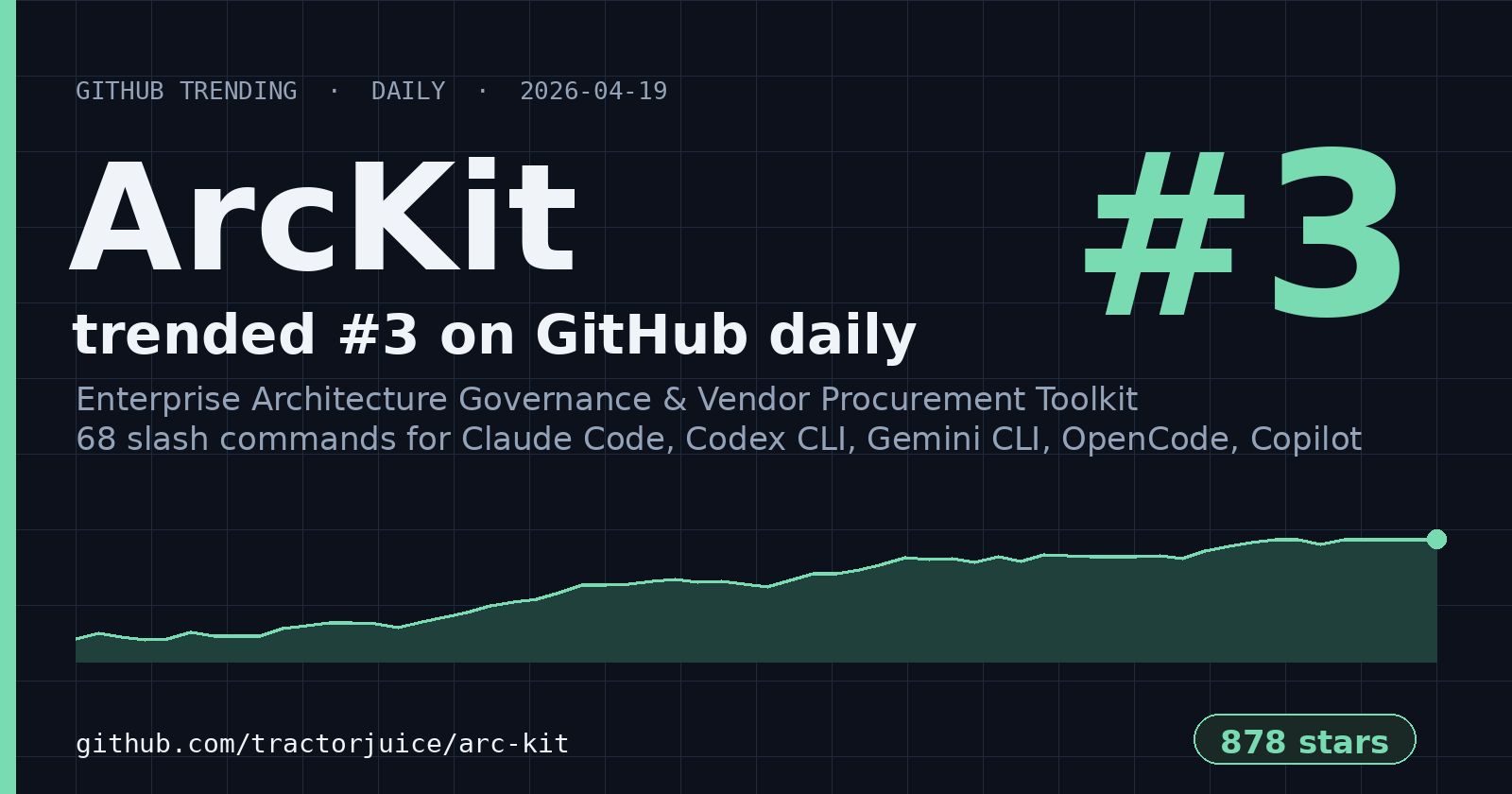
A few hours after I shipped v4.6.13, a friend sent me a screenshot. ArcKit was sitting at number three on GitHub's daily trending list, wedged between a Mozilla Thunderbird spinoff and OpenAI's agents library. 878 stars. I refreshed the page about six times before I believed it.
If you had told me three months ago that a toolkit for Enterprise Architecture governance — a domain most developers would rather chew glass than read about — would be trending alongside models, agents, and developer tooling, I would have smiled politely and changed the subject. But here we are. And I don't think it's a fluke. I think it's a signal about where the AI tooling conversation is quietly moving.
What actually trended
ArcKit is a set of 68 slash commands for AI coding assistants — Claude Code, Codex CLI, Gemini CLI, OpenCode, GitHub Copilot — that turn the blank page of "we need to do some architecture work" into a structured, template-driven process. You ask for requirements, it generates requirements. You ask for a business case, a data model, a stakeholder map, an ADR, a Wardley Map, a risk register — it generates those too, each one traceable back to the principles and stakeholders that came before it.
Under the hood it is not exotic. It is markdown templates, bash helpers, and a disciplined prompt library. Above the hood it is something a bit unusual: a toolkit that treats governance as a first-class product rather than a compliance afterthought.
Why the timing feels right
The AI coding tools of the last year have optimised for speed. Write this function. Fix this bug. Refactor this module. They are astonishingly good at the inner loop of development. But the outer loop — the questions that come before a line of code is written — has been neglected. What problem are we solving? Who are the stakeholders? What are the non-functional requirements? What are the legal constraints? What should we build versus buy? What does the business case actually look like?
Those are the questions that consume senior architects and that, until recently, no AI tool meaningfully helped with. The gap was not technical capability. The gap was structure. Large language models can write a decent requirements document, but they will happily produce a decent-but-different requirements document every single time, with no traceability to anything upstream or downstream. That is useless in a regulated environment and barely better than useless in an unregulated one.
The insight behind ArcKit is that the structure matters more than the generation. You give the model a template, a document identifier convention, a traceability chain, and a governance framework, and suddenly the output is not a disposable draft. It is an artifact you can review, version, approve, and hand to a delivery team.
The public-sector tell
One quiet signal in the trending moment: ArcKit's biggest early adopters have been UK public-sector technologists. The toolkit is opinionated about the GDS Service Standard, the Technology Code of Practice, NCSC's Cyber Assessment Framework, and the HM Treasury Green and Orange Books. None of those acronyms fit on a hoodie. All of them appear, daily, in the work of the civil servants trying to digitise government services under political pressure with flat budgets.
If you are a central-government CTO office, you have spent years being told that AI tooling would help you move faster. What you actually needed was something that helped you move faster while staying within the rules. That gap is where ArcKit landed, and I think that is a large part of why it has travelled so quickly through that community.
What the trending moment does and does not mean
GitHub trending is a velocity metric, not a mass one. A 900-star repo can sit next to a 40,000-star repo because what trending measures is change, not size. I am not claiming ArcKit has displaced anyone. I am saying the rate at which people are finding it and starring it is, for a brief moment, in the same league as much larger projects. That matters because it tells me the underlying audience — architects, public-sector technologists, AI tooling builders — is hungrier for this kind of tool than I expected when I started.
What's next
The roadmap is open and messy, which is how I like it. A genuinely non-UK-specific version is in design, with contributor interest from Austria and Australia. Connecting ArcKit's agents to external knowledge systems — AWS, Azure, GCP documentation, UK government code repositories, EU Open Data — is happening in pieces. A growing test-repository fleet covers everything from HMRC chatbots to Scottish Courts GenAI strategy to UAE investment-promotion frameworks, each one a real example of what the toolkit produces on a real problem.
If the last decade of open source taught me anything, it is that infrastructure-shaped projects trend once, then either die quietly or compound for years. I do not know yet which one this will be. But the fact that governance — of all things — is what showed up on trending this weekend suggests the conversation is shifting, and I would rather help shape that shift than watch it from the sidelines.
If you are an architect, a public-sector technologist, or anyone responsible for turning ambiguous organisational goals into defensible technical decisions, ArcKit is worth ten minutes of your time. The repository is at github.com/tractorjuice/arc-kit. I would love to hear what breaks when you point it at your real problems.
Publication notes
- Tone applied: neutral professional, first-person reflective (Medium default)
- Word count: ~940
- No tables (per request)
- Suggested Medium tags:
Enterprise Architecture,GitHub,AI Tools,Open Source,Public Sector - Suggested hero image: screenshot from
docs/milestones/arckit-trending-2026-04-19.html
SEO
- Primary keyword: enterprise architecture AI tooling
- Secondary: AI coding assistant governance, Claude Code plugin, UK government digital
- Meta description (≤160 chars): ArcKit trended on GitHub this weekend — a slash-command toolkit that turns AI coding assistants into structured Enterprise Architecture generators.
Related Articles
- Product Hunt Launch: ArcKit
- Show HN: ArcKit — Architecture Governance as Slash Commands
- ArcKit on Product Hunt — LinkedIn Launch Post
- The People Behind ArcKit: Open Source Contributors
Join the ArcKit Community
- Discord — real-time conversation, help with commands, and what people are building: discord.gg/HsA4Y3hQ4
- LinkedIn Group — announcements, case studies, and longer-form discussion: linkedin.com/groups/17641034
- GitHub — code, issues, and contributions: github.com/tractorjuice/arc-kit