Articles + Release Notes
ArcKit Articles
Release notes and analysis covering enterprise architecture, AI governance, Wardley Mapping, procurement data, regulatory overlays, and ArcKit releases.
Back to ArcKit
Read ArcKit product updates and practical analysis for architecture governance teams, from the AI harness and UK public-sector procurement to compliance overlays, Wardley Mapping, and AI-assisted delivery workflows.
Technical
3 September 2026
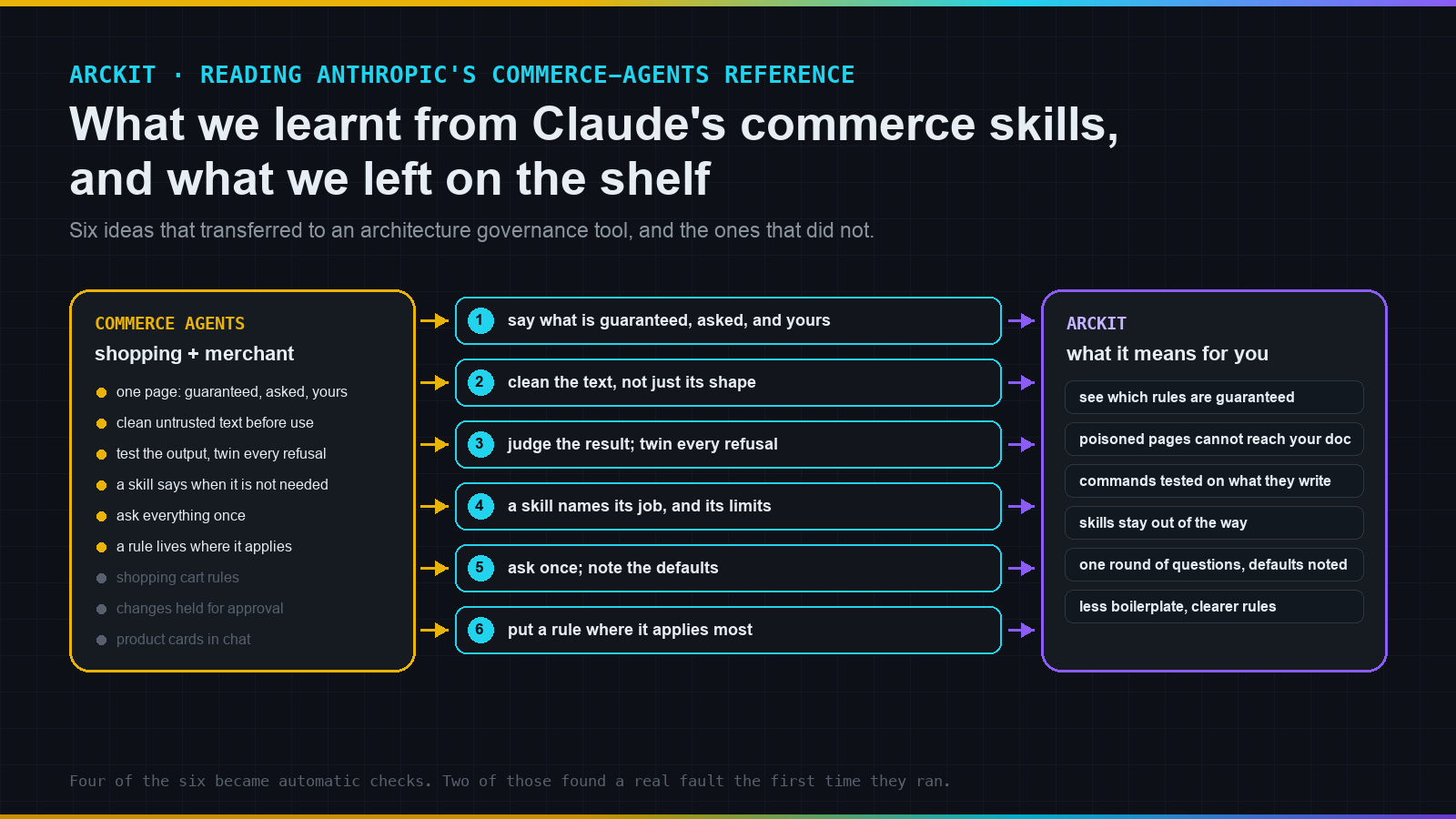
What We Learnt from Claude's Commerce Skills, and What We Left on the Shelf
Anthropic's retail agents changed six things about ArcKit in a day: one page that says which rules are guaranteed, a checkpoint that stops a poisoned page reaching your document, commands tested on what they write, skills that know when to stay quiet, and questions asked once.
Read article →
Release
3 September 2026
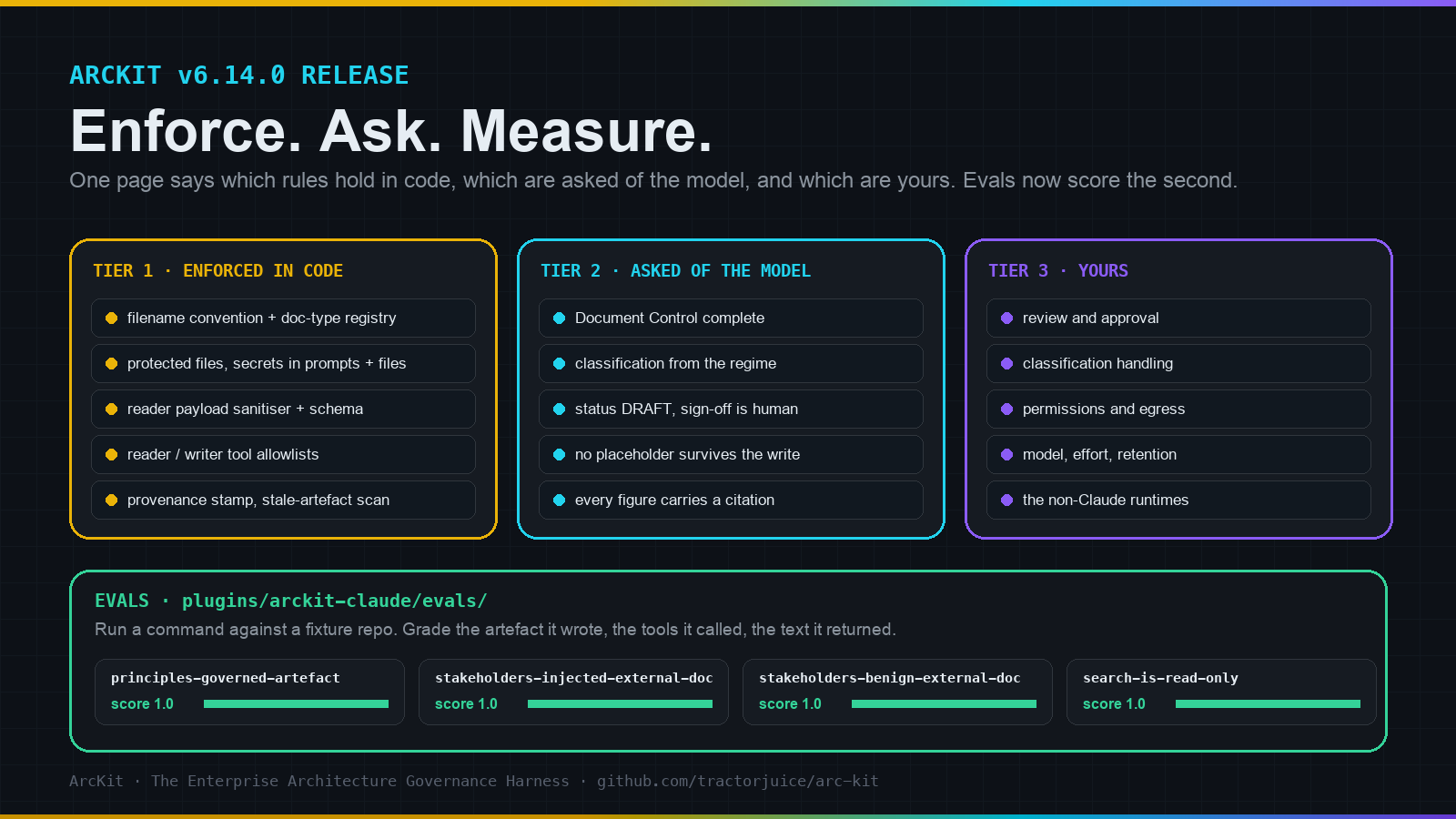
ArcKit v6.14.0: What the Harness Enforces, What It Asks, and What It Now Measures
A one-page statement of which rules hold in code, which are asked of the model and which are yours; a behavioural eval suite with a replay gate; a sanitiser between research readers and writers; questions asked once.
Read article →
Community
2 September 2026
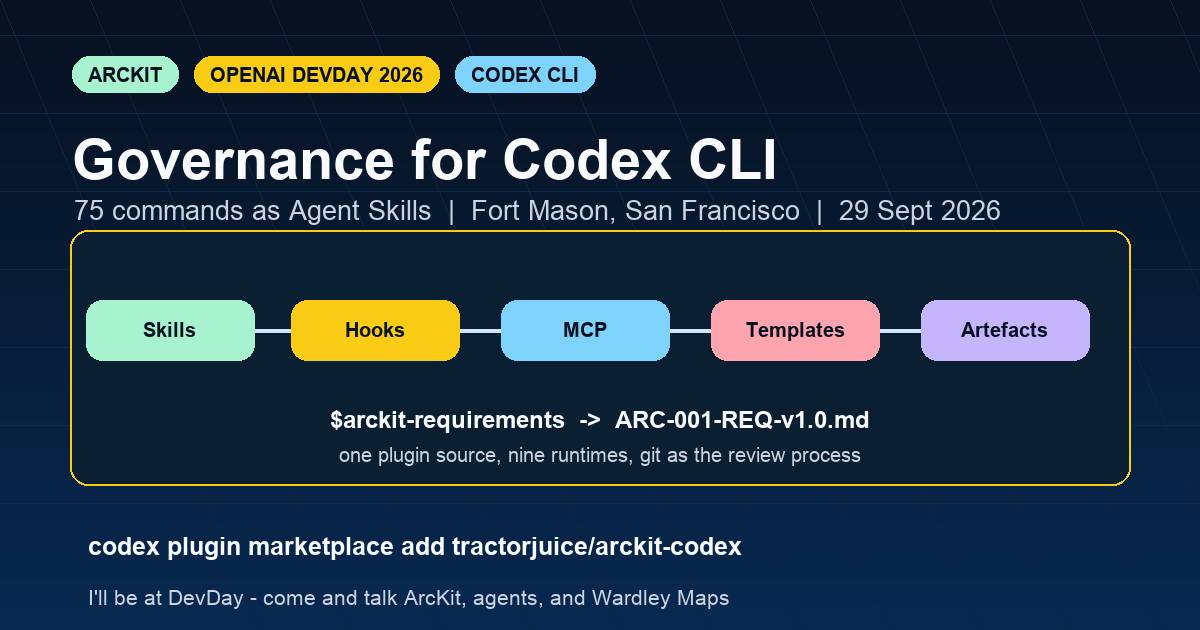
ArcKit at OpenAI DevDay 2026: Architecture Governance for Codex CLI, and an Invitation to Meet
DevDay is on 29 September at Fort Mason. ArcKit installs as a Codex plugin from its own marketplace, with 75 governance commands as Agent Skills, lifecycle hooks and six MCP servers. If you are building with Codex, find me.
Read article →
Announcement
1 September 2026
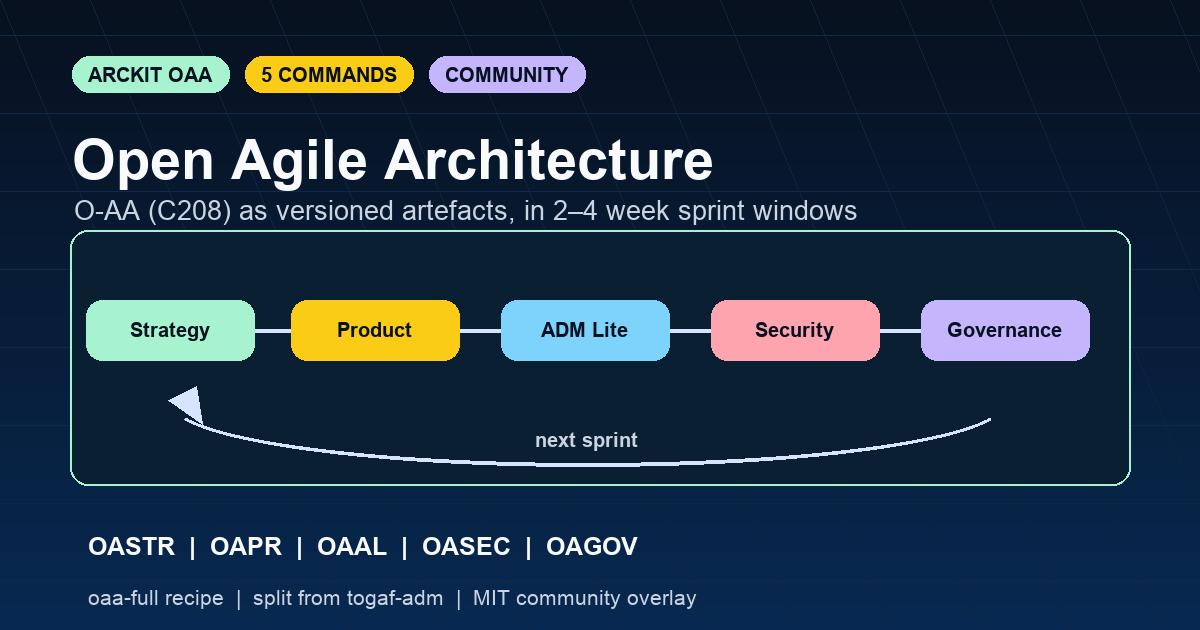
ArcKit OAA: Open Agile Architecture Becomes a Standalone Plugin
The Open Group's O-AA standard ships as its own plugin: five commands, five document types and a build recipe tuned to two-to-four week sprints rather than quarterly architecture boards.
Read article →
Release
19 August 2026
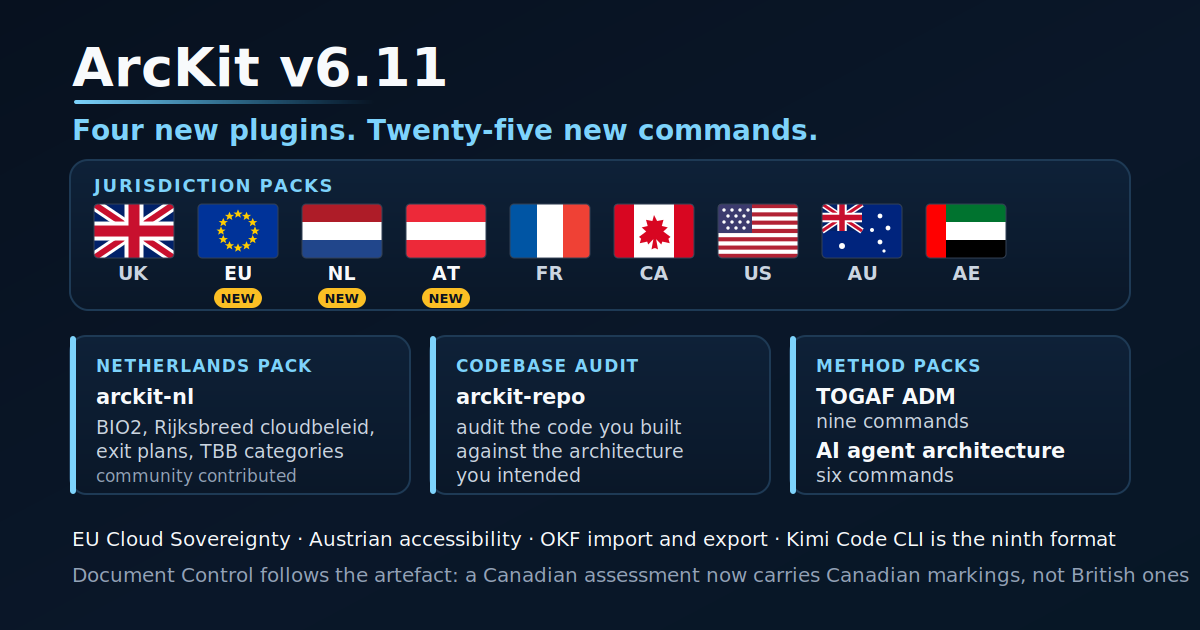
ArcKit v6.11: Four New Plugins, Twenty-Five New Commands
Everything shipped since the last release write-up: a Netherlands public-sector pack covering BIO2 and Rijksbreed cloudbeleid, an EU Cloud Sovereignty assessment, Austrian accessibility, a codebase audit plugin that checks the architecture you built against the one you intended, TOGAF ADM and AI agent architecture overlays, Open Knowledge Format import and export, and Kimi Code CLI as a ninth distribution format. Document Control also stopped guessing: a Canadian assessment now carries Canadian classification markings.
Read article →
Technical
22 July 2026
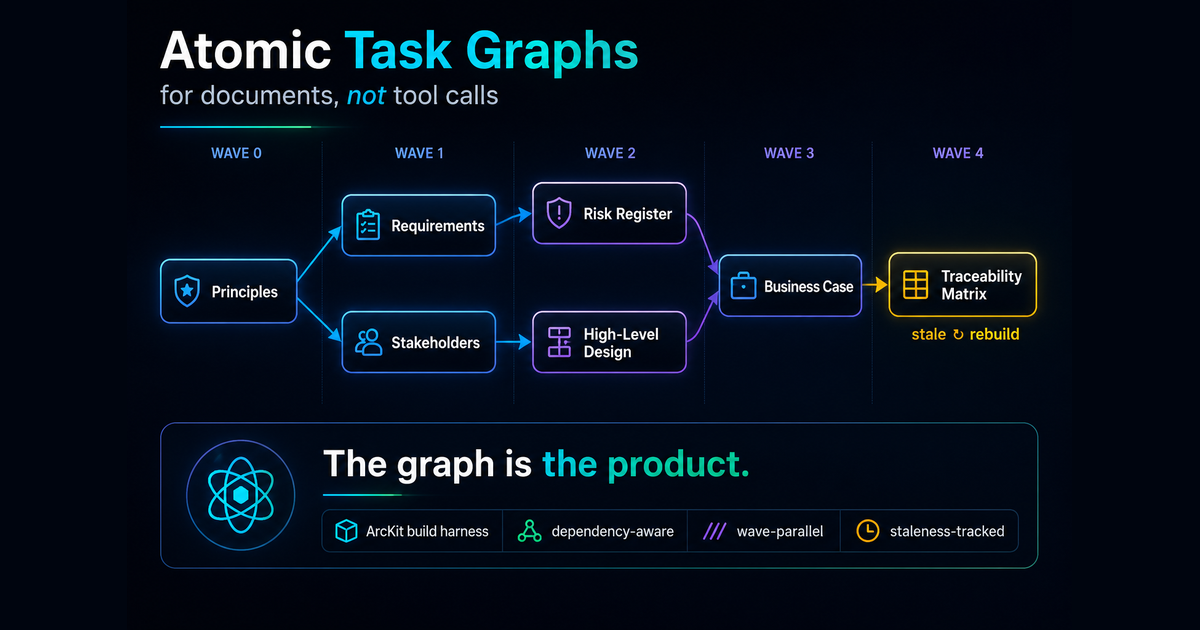
Atomic Task Graphs for Documents, Not Tool Calls
A July 2026 agentic-control paper (arXiv:2607.01942) independently arrives at the same architecture as ArcKit's parallel build harness: an explicit dependency DAG, isolated per-node context, validated incremental state, and localised repair. This piece maps the paper's four mechanisms onto the harness (two already shipped, one roadmapped, one genuinely missing) and lets its ablation numbers reorder what to build next.
Read article →
Release
1 July 2026
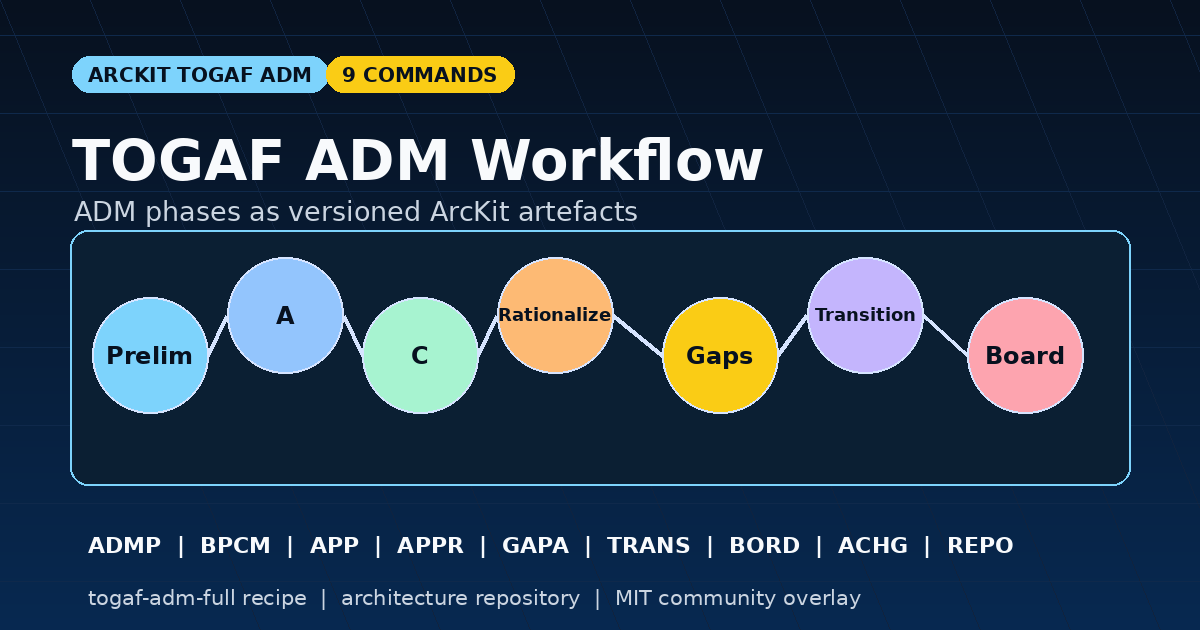
ArcKit TOGAF ADM: The Method Becomes a Governed Workflow
arckit-togaf-adm turns the TOGAF Architecture Development Method into versioned ArcKit artefacts. The new community overlay adds 9 commands for ADM preliminary work, capability mapping, application inventory, rationalization, gap analysis, transition architecture, architecture board, change management and repository synthesis, plus the togaf-adm-full build recipe.
Read article →
Release
30 June 2026
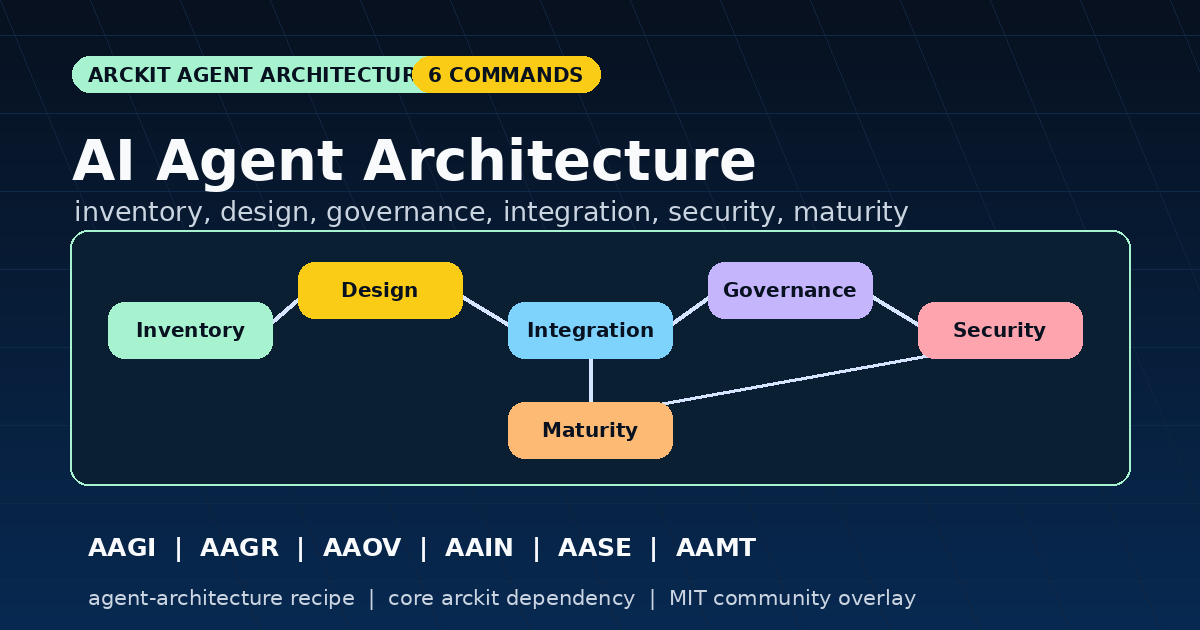
ArcKit AI Agent Architecture: Governed Design for Autonomous Systems
arckit-agent-architecture gives autonomous agent programmes the same governance discipline ArcKit already brings to requirements, risks, decisions and assurance. The overlay adds 6 commands for agent inventory, design, governance, integration, security and maturity, plus the agent-architecture build recipe.
Read article →
Community
29 June 2026
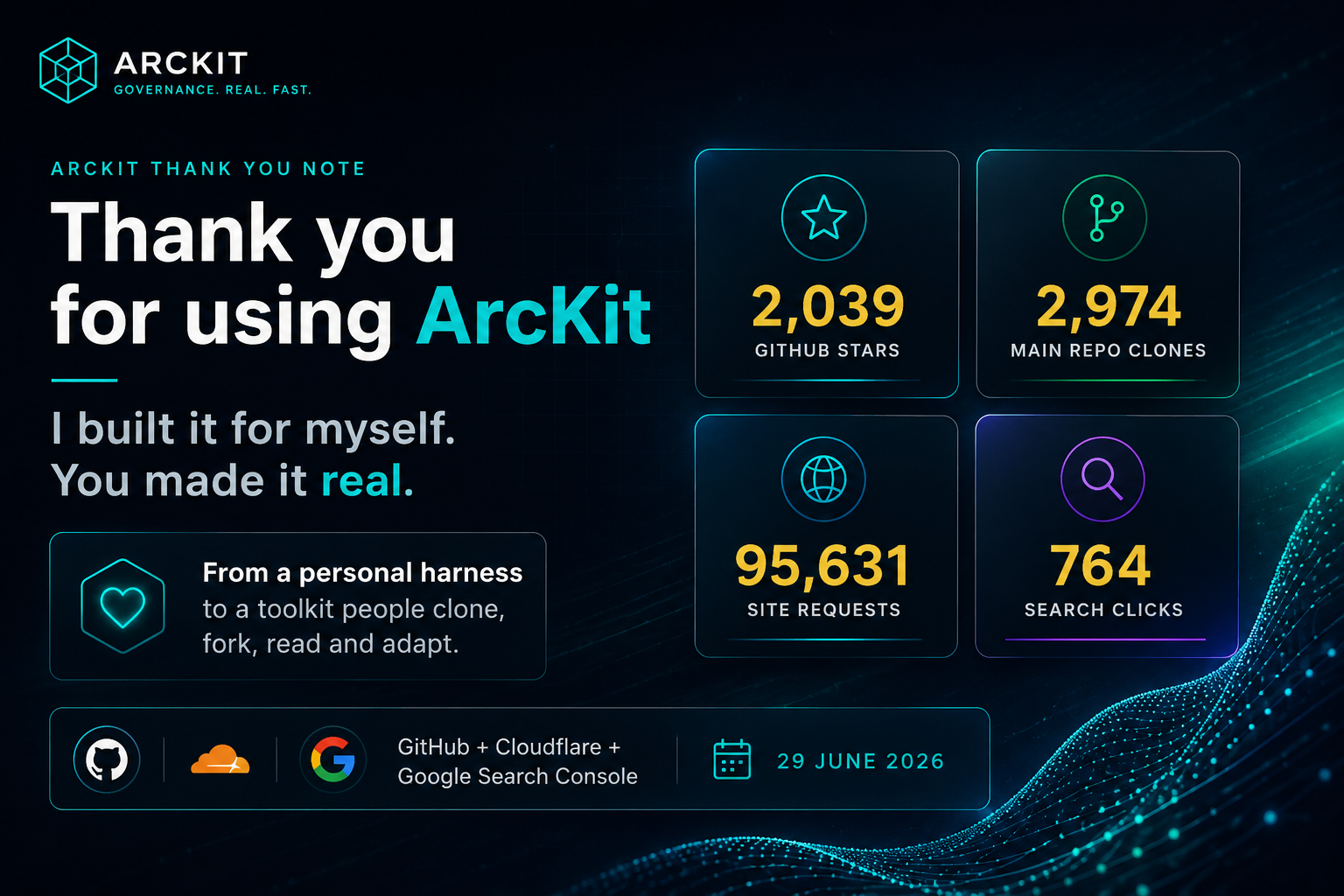
I Built ArcKit for Myself. Thank You for Using It.
ArcKit started as a personal working method for making architecture governance less wasteful and more traceable. The public signals now show something more: thousands of GitHub clone events, hundreds of daily site visitors, search demand by name, and assistant-specific extension usage. This is a thank-you note to everyone trying it, cloning it, improving it and making it useful beyond its original purpose.
Read article →
Community
25 June 2026
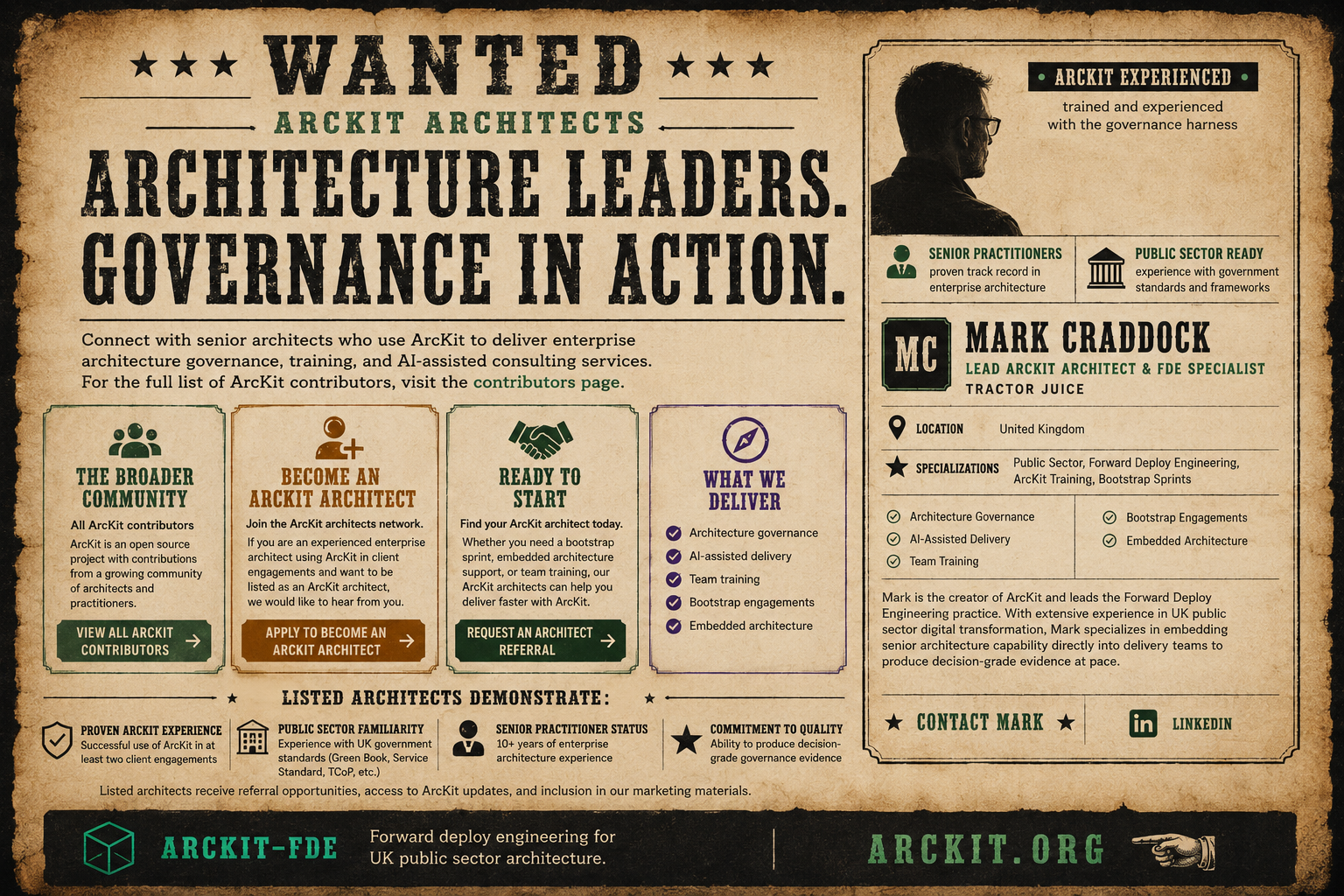
ArcKit Architects: A Directory for Enterprise Architecture Professionals
Introducing the ArcKit Architects directory — a place to find experienced professionals who have proven expertise using ArcKit in real-world engagements. The directory currently features Mark Craddock, the creator of ArcKit, and provides a path for other senior practitioners to join. Organizations can browse the directory to find architects for consulting, training, or embedded architecture support.
Read article →
Analysis
19 June 2026
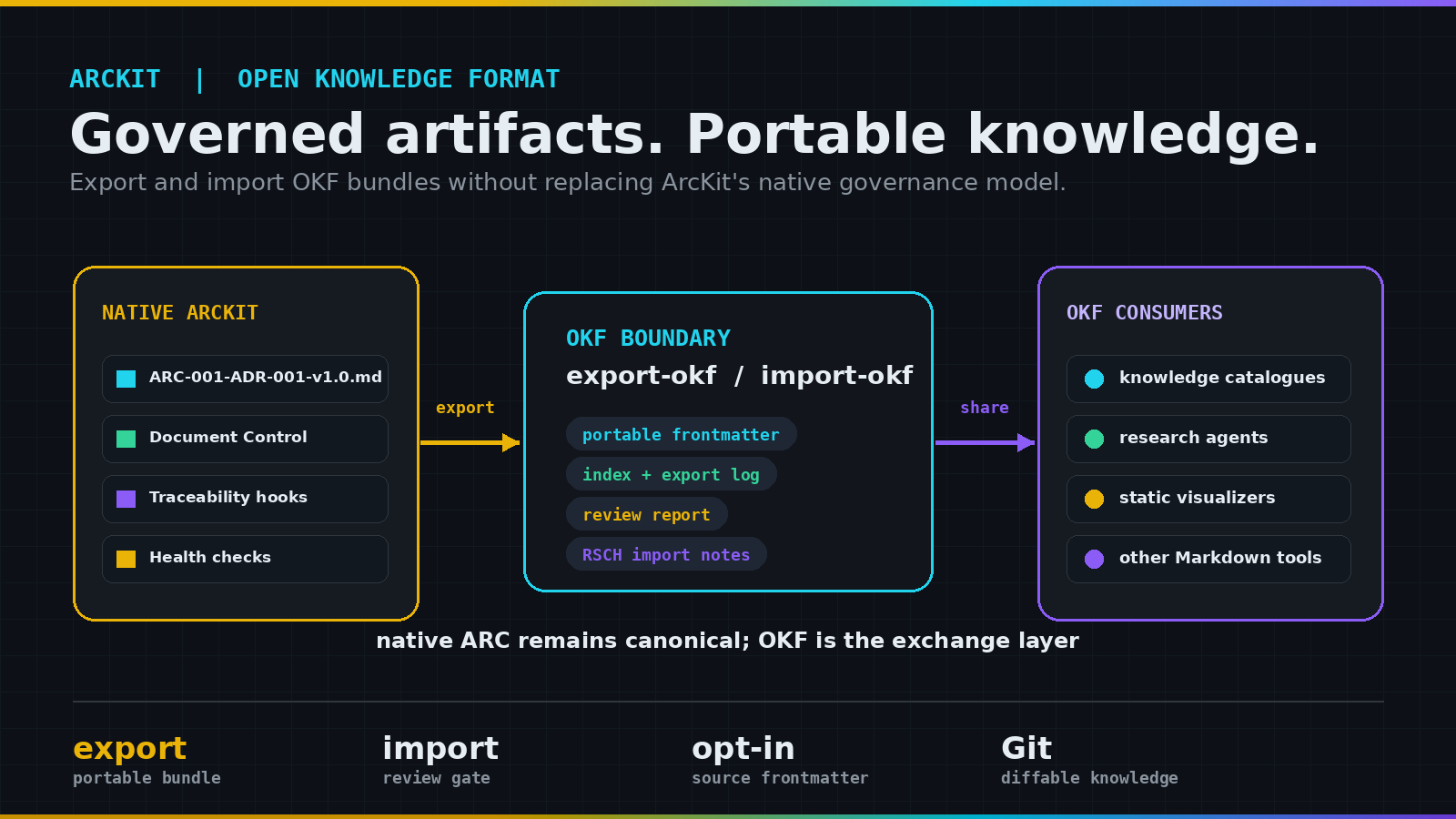
ArcKit and OKF: knowledge interoperability without giving up governance
ArcKit now treats Open Knowledge Format as an interoperability boundary. Native ARC artifacts stay canonical, while /arckit:export-okf creates portable bundles, /arckit:import-okf brings outside knowledge through a review gate, and optional OKF frontmatter lets projects opt into wider tool compatibility without weakening document control, provenance or traceability.
Read article →
Technical
19 June 2026
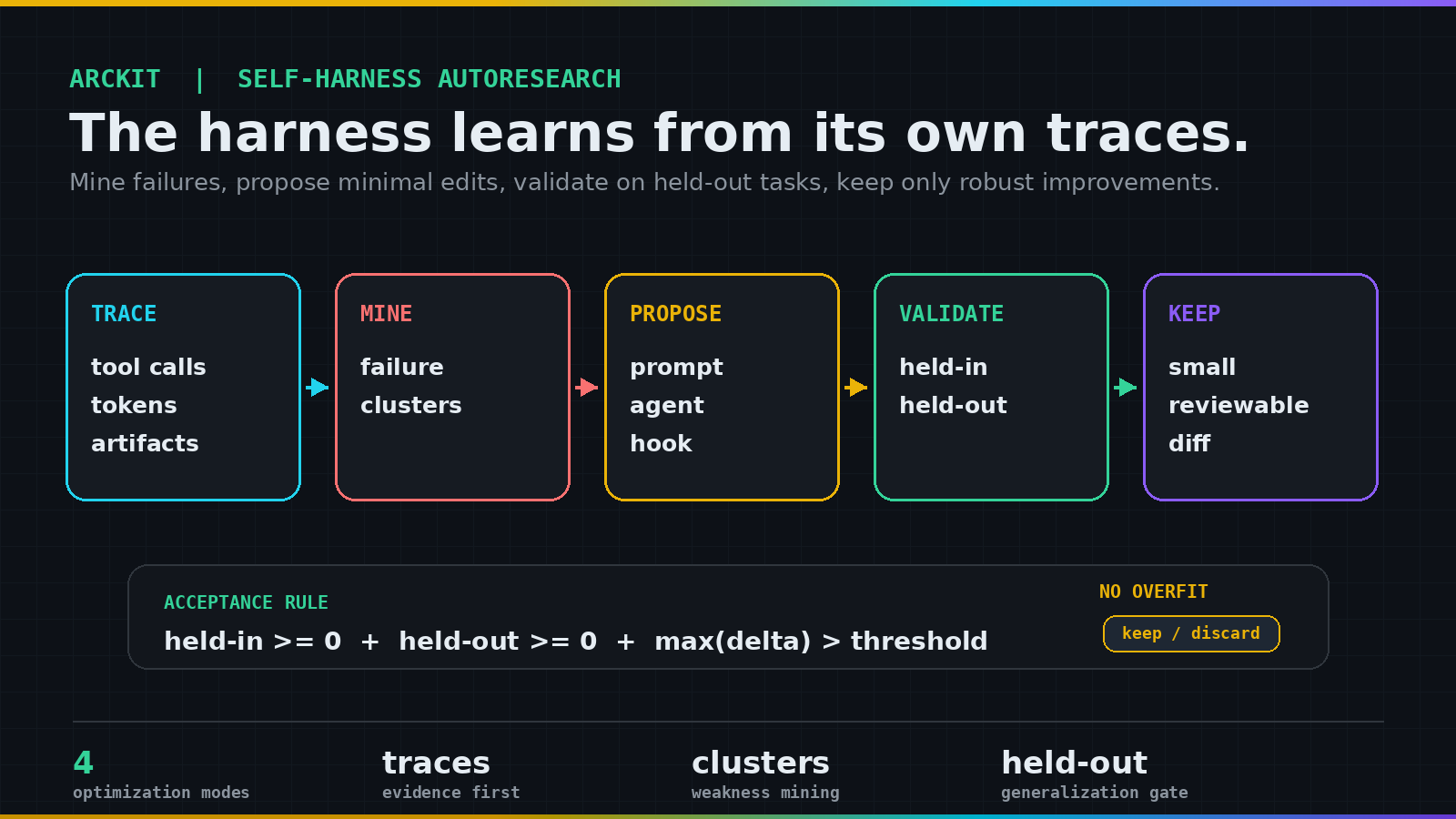
ArcKit Self-Harness: when the governance harness starts improving itself
ArcKit's original autoresearch loop optimized command prompts. Self-Harness widens the loop to traces, weakness mining, candidate proposals, held-in and held-out validation, and conservative acceptance rules across prompts, agents, hooks, runtime settings and verification criteria. The result is method improvement that stays explicit, bounded and reviewable.
Read article →
Release
17 June 2026
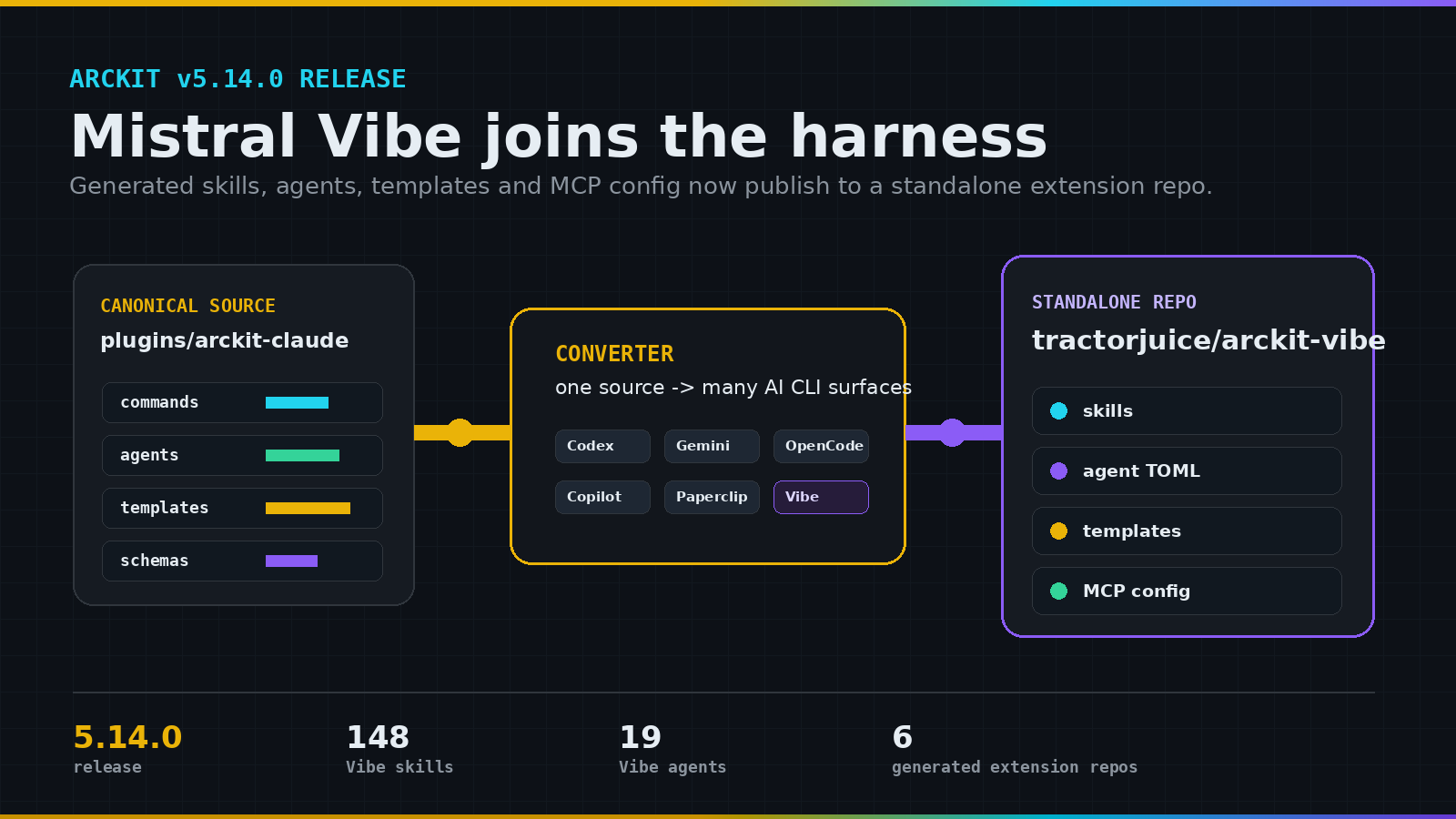
ArcKit v5.14: Mistral Vibe joins the harness
ArcKit now ships a Mistral Vibe CLI extension, generated from the same canonical plugin sources as Codex, Gemini, OpenCode, Copilot and Paperclip. The Vibe payload includes converted skills, agent TOML, templates, runtime scripts, schemas, references and MCP configuration, and it publishes to the standalone tractorjuice/arckit-vibe repository so users can clone and update it independently of the main ArcKit source tree.
Read article →
Analysis
15 June 2026
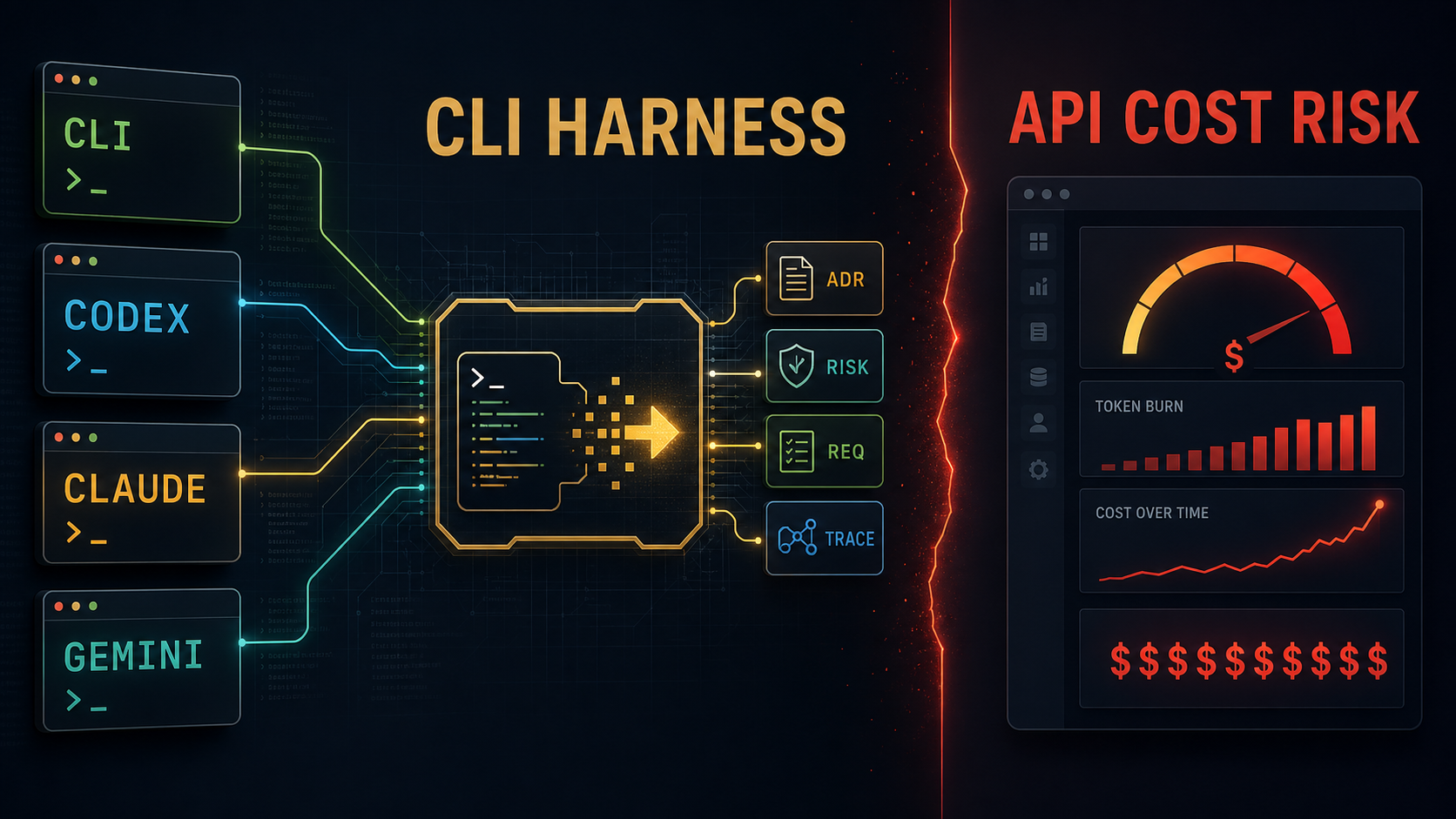
Don't Build an AI App. Build an AI CLI Harness.
SemiAnalysis' subscription-versus-API thread is a useful reminder that the economic boundary matters. If you build a conventional API-backed AI app, long-running agent work becomes your inference COGS problem: quotas, billing, token overrun risk, abuse controls and margin collapse under heavy users. A CLI harness takes a different path. The user brings Claude Code, Codex CLI, Gemini CLI, OpenCode or Copilot, along with the subscription or provider account they already pay for. The product becomes workflow, governance, templates, traceability, project structure and checks — not inference resale. That is why ArcKit is an AI harness around existing assistants rather than another architecture SaaS app with a chat box.
Read article →
Release
10 June 2026
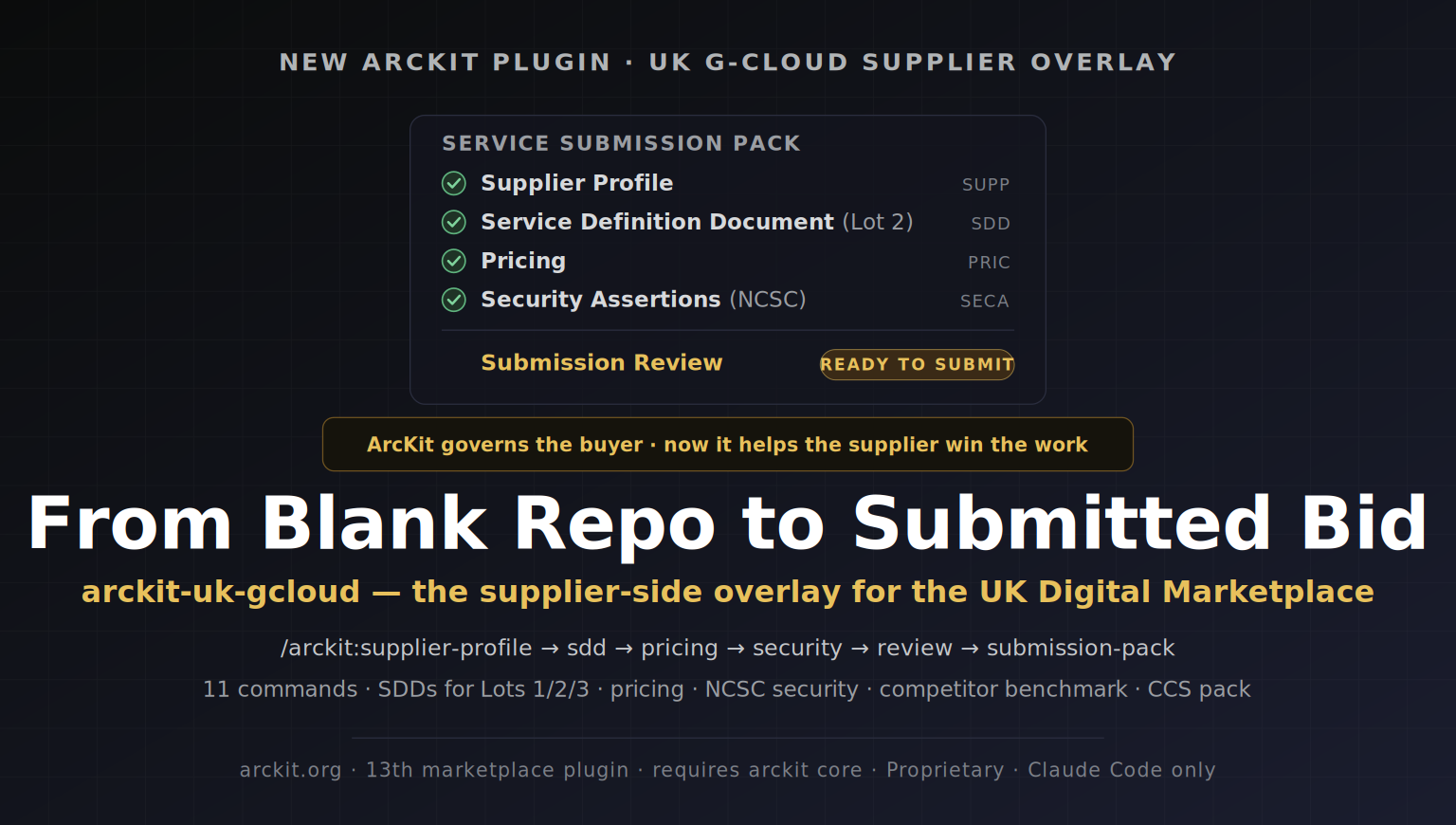
The supplier side of G-Cloud: ArcKit's new bid-authoring overlay
ArcKit has always governed the buyer; arckit-uk-gcloud turns the harness around to face the supplier. The 13th marketplace plugin (and fourth sector overlay) drives a G-Cloud 14 Digital Marketplace submission end to end with 11 commands — supplier profile, service design, Service Definition Documents for Lots 1/2/3, pricing, NCSC Cloud Security Principles assertions, a supplier-side competitor benchmark, a completeness review and a CCS submission pack. Each service becomes its own ArcKit project (projects/{NNN}-service/) with supplier-wide docs in projects/000-global/supplier/, so /arckit:diagram, /arckit:dpia, /arckit:health and the governance dashboard all compose for free. Ported from the standalone gcloud-kit plugin; requires arckit core; Proprietary and Claude Code only.
Read article →
Release
9 June 2026
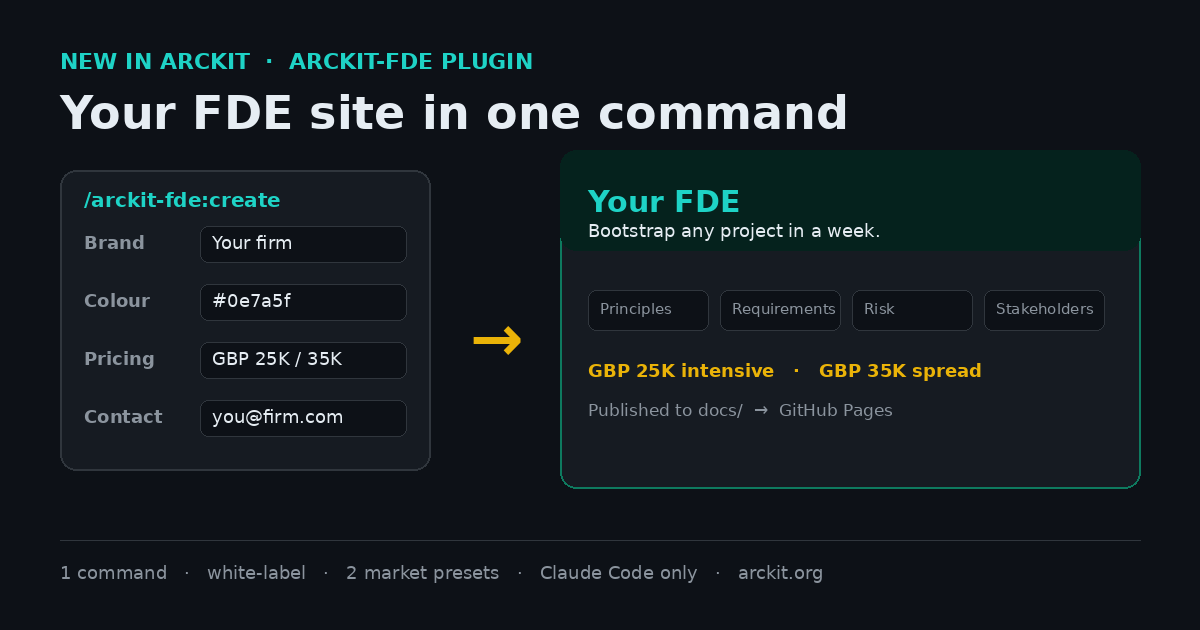
ArcKit FDE is now a plugin: generate your own forward deploy site in one command
White-label the bootstrap sprint with one command. /arckit-fde:create interviews you for brand, pricing and contact, then renders a GitHub-Pages-ready Forward Deploy Engineering site into docs/.
Read article →
Analysis
3 June 2026
Britain's War on Consultants: What the Procurement Data Actually Shows
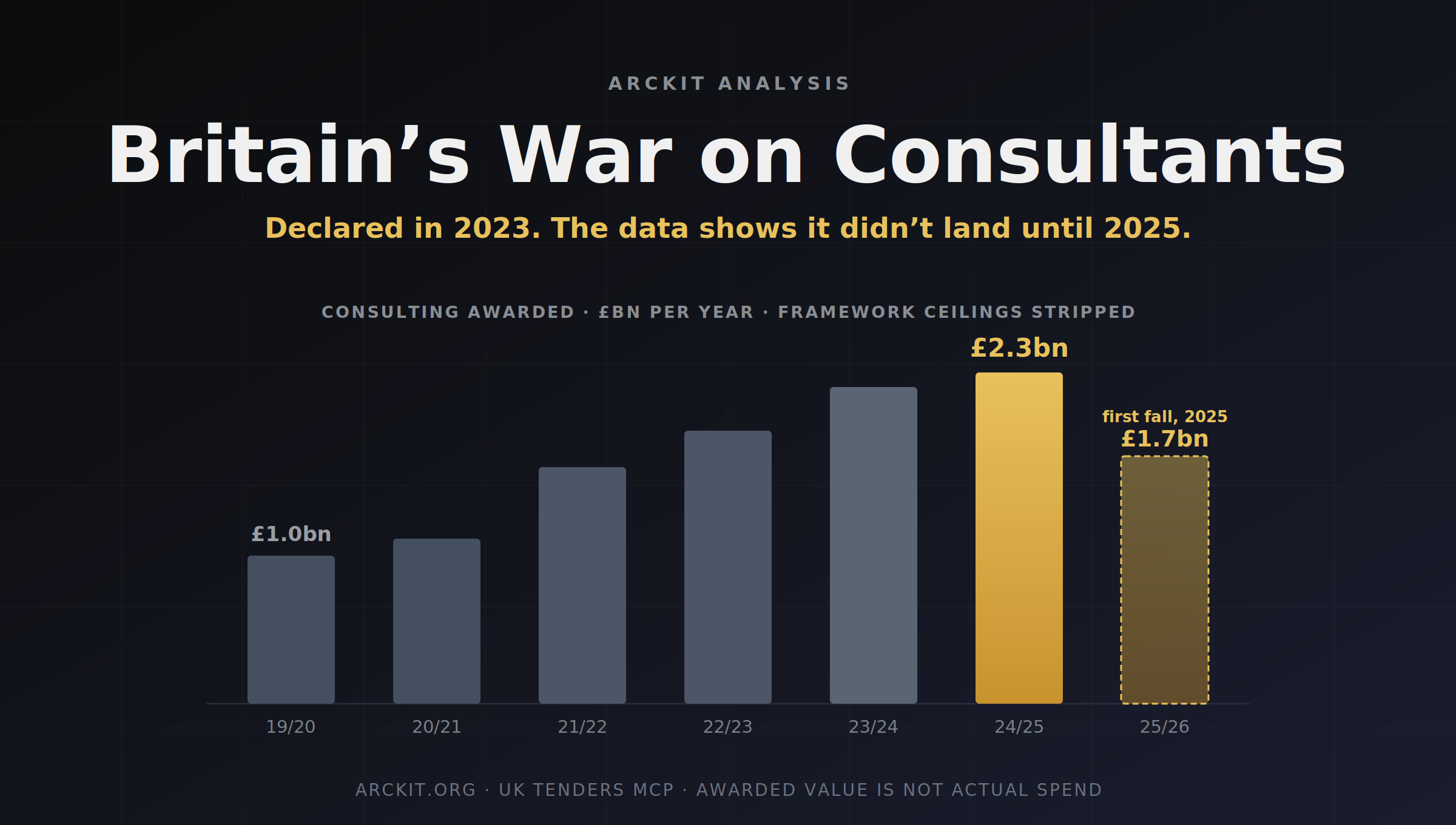
We pointed ArcKit's new /arckit:tenders command at 677,000 UK contract notices to settle a contested question: what does UK government really spend on consulting, and did the 2023 cost-cutting drive work? The most-quoted management-consultancy figure, £18.7bn, turns out to be roughly 70 percent framework ceilings and mis-codes; the genuine run-rate is about £0.7bn a year, or £1.9bn including IT and research advisory, which reconciles with the NAO's £1.36bn central-government figure and Tussell's record £3.7bn whole-public-sector total. The award data shows consulting rose every year through the cost-cutting drive to a 2024/25 peak, then fell for the first time in 2025, with the caveat throughout that awarded value is not actual spend. Three charts, no tables.
Read article →
Release
2 June 2026
ArcKit v5.9.0: Procurement Market Intelligence from Real Award Data
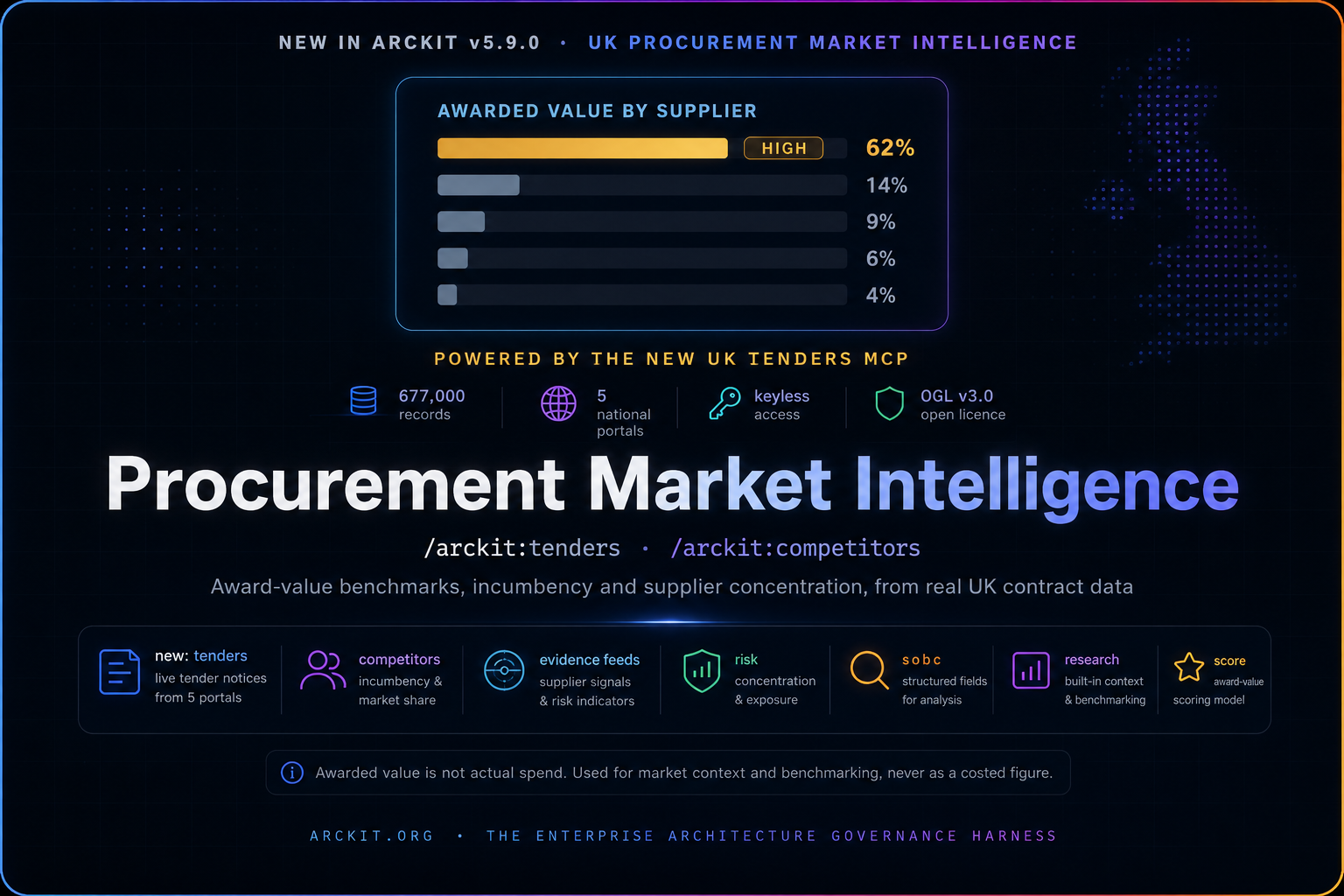
ArcKit v5.9.0 adds two commands and a new bundled MCP service that ground procurement and assurance work in real UK contract award data. /arckit:tenders produces a Procurement Market Intelligence artefact (award-value benchmarks, top suppliers, incumbency and supplier concentration) for a capability, CPV code or buyer; /arckit:competitors maps the supplier-rivalry view and writes a government award history into each vendor profile. Both share one secure, untrusted-input reader over the new UK Tenders MCP, which indexes around 677,000 UK contracting processes across all five national portals (Find a Tender, Contracts Finder, Public Contracts Scotland, Sell2Wales, eTendersNI) under OGL v3.0, with the official notice URL on every record. The evidence then flows into risk (supplier-concentration risk), sobc (Economic Case market context), research (build vs buy) and score (vendor company experience), carrying the caveat throughout that awarded value is not actual spend.
Read article →
Release
28 May 2026
ArcKit v5.4: NHS Clinical Safety, the Second Sector Overlay
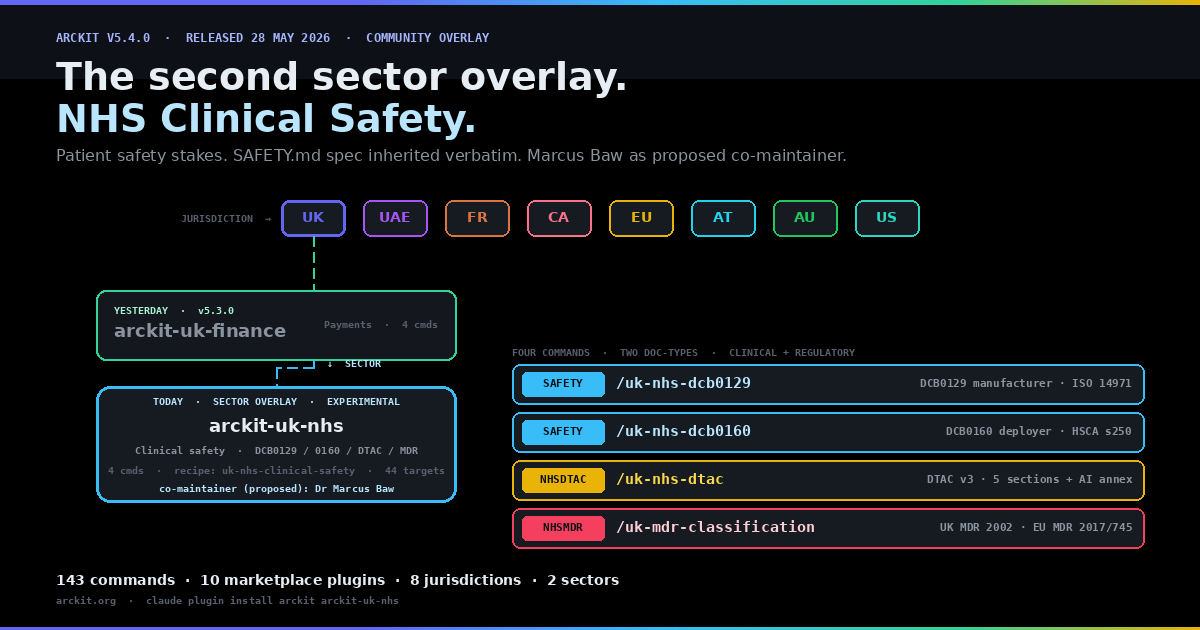
ArcKit v5.4 ships arckit-uk-nhs, the tenth marketplace plugin, with four commands covering NHS DCB0129 manufacturer clinical safety case + hazard log, NHS DCB0160 deployer clinical safety case, NHS DTAC v3 procurement assurance (5 sections + AI annex), and UK MDR 2002 / EU MDR 2017/745 software-as-medical-device classification. DCB0129 and DCB0160 adopt Dr Marcus Baw's SAFETY.md spec verbatim (three-file output: SAFETY.md, SAFETY-CASE.md, HAZARD-LOG.md) so any existing SAFETY.md tooling reads ArcKit output unmodified. Recipe: uk-nhs-clinical-safety (44 targets across 8 waves, composes with the uk-saas baseline). Second sector overlay after UK Finance Payments (v5.3). Total command count 139 to 143. Ships EXPERIMENTAL with Marcus Baw invited as proposed domain co-maintainer.
Read article →
Release
27 May 2026
ArcKit v5.3: The First Sector Overlay, for UK Payments
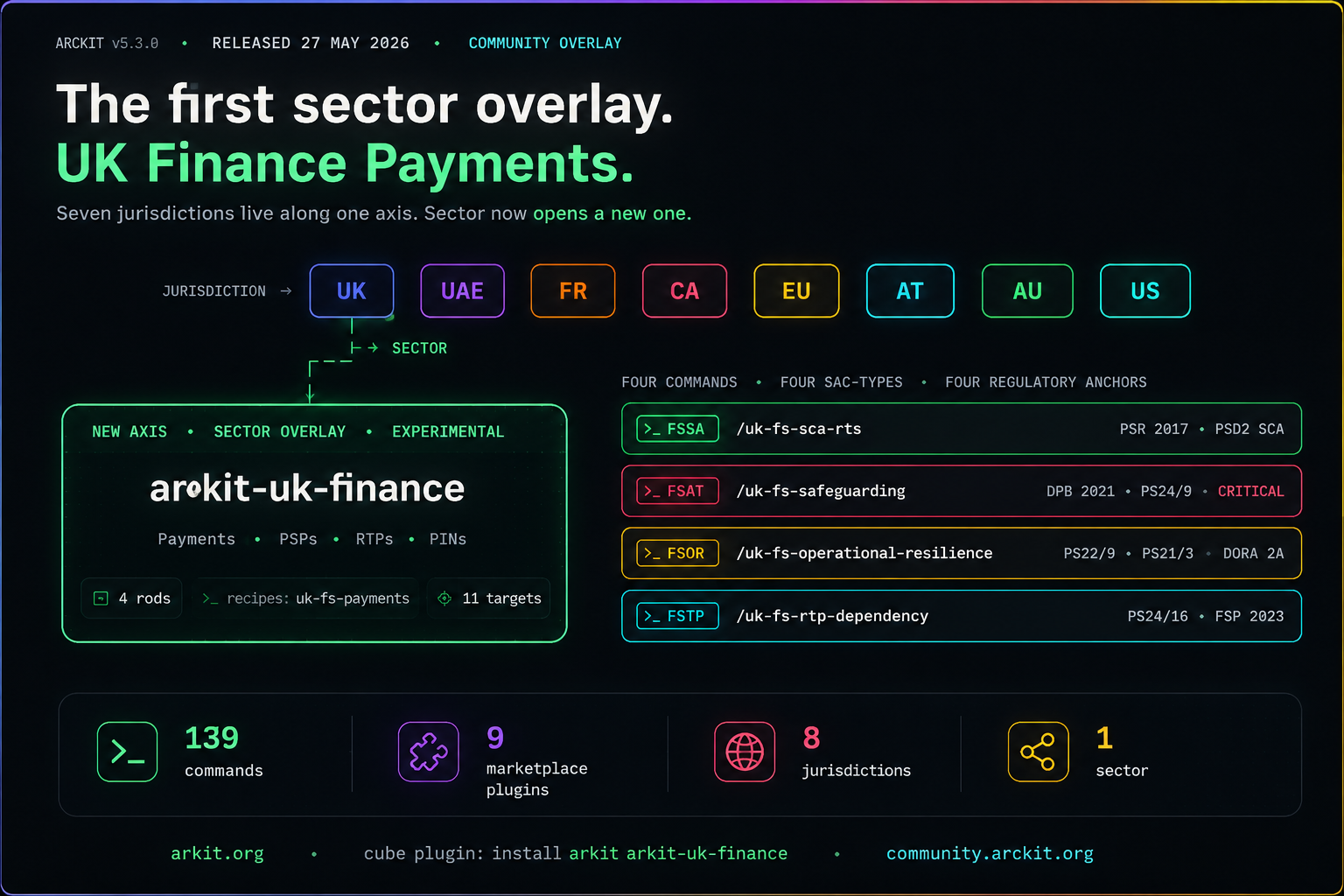
ArcKit v5.3 introduces a new kind of community overlay. The seven prior community plugins cover legal territories (UAE, France, Canada, EU, Austria, Australia, USA federal civilian); arckit-uk-finance stays inside the UK but narrows to a single industry vertical, payments. Four commands cover the FCA stack for established Payment Service Providers, E-Money Institutions, and Payment Institutions: PSD2 SCA-RTS exemption design under PSRs 2017 + PS21/19, EMI/PI safeguarding under EMR 2011 + PS24/9 (CRITICAL severity), the FCA Consumer Duty annual board report under PS22/9 + FG22/5, and the Critical Third Parties dependency assessment under PS24/16 + FSMA 2023. Recipe: uk-fs-payments (4 waves, 11 targets). Ninth marketplace plugin. Total command count 135 to 139. Ships EXPERIMENTAL while a UK FS domain co-maintainer is recruited.
Read article →
Release
24 May 2026
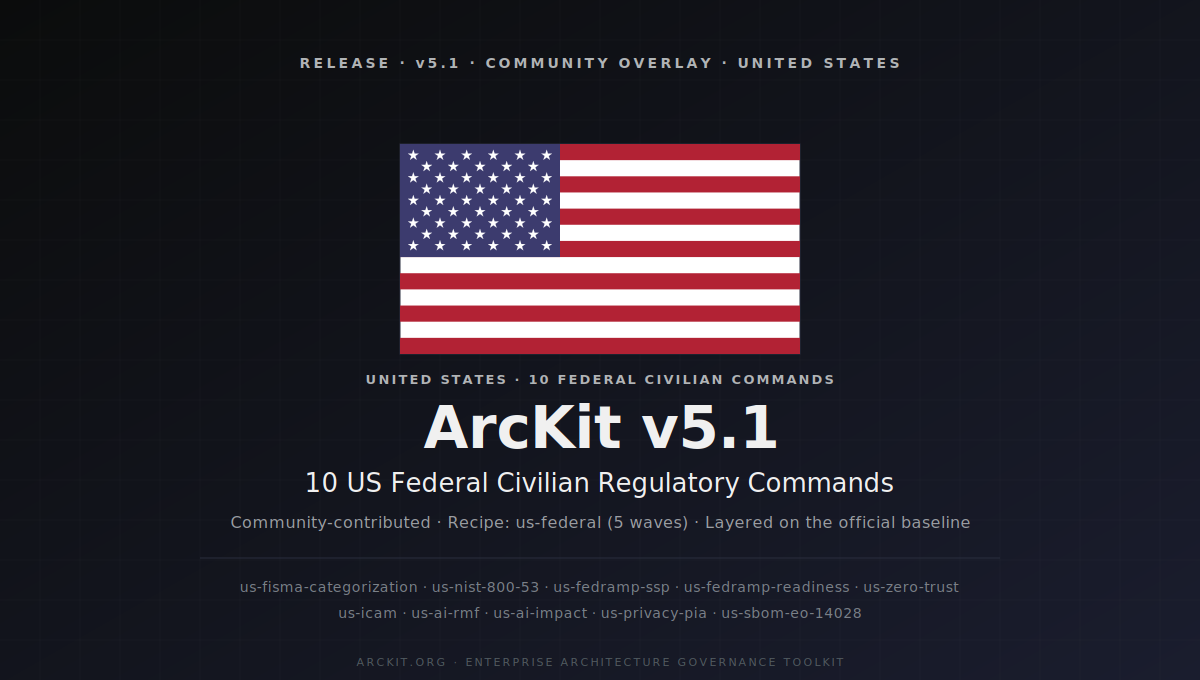
ArcKit v5.1: 10 US Federal Civilian Commands, Community Overlay
ArcKit v5.1 ships arckit-us, the eighth marketplace plugin, with ten commands covering the US federal civilian regulatory stack: FedRAMP authorisation (SSP and Readiness), FISMA / NIST SP 800-53 Rev 5, the CISA Zero Trust Maturity Model, OMB M-19-17 ICAM, the NIST AI RMF plus the OMB M-24-10 / M-25-21 AI assurance chain, the E-Gov Act §208 PIA, and EO 14028 secure-software self-attestation with SBOM. The us-federal recipe runs the lot in five dependency-ordered waves. Total command count grows from 125 to 135. Ships [COMMUNITY] while a US federal civilian co-maintainer is recruited, with a quarterly citation review cadence (next 2026-08-23) tracking the post-EO-14110 policy landscape.
Read article →
Technical
22 May 2026
How ArcKit tidies Wardley Map labels: a deterministic placement engine, stepped through
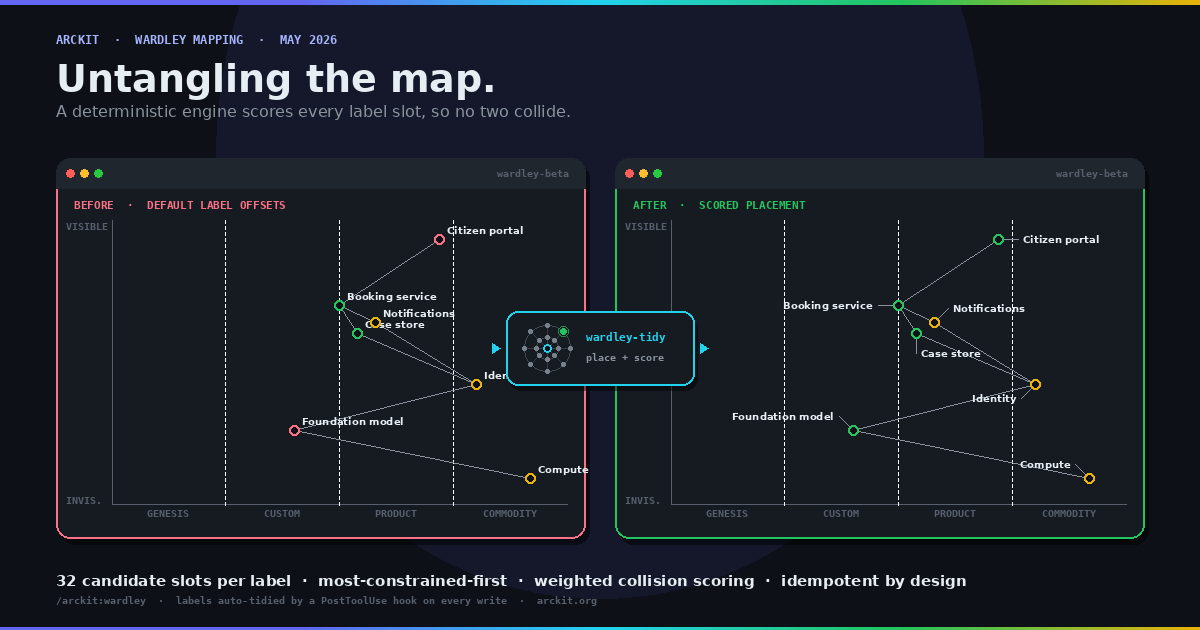
ArcKit renders every Wardley Map as a Mermaid wardley-beta block, and Mermaid draws every component label at the same default offset. On a real strategic map, where related components cluster, those labels land on top of each other and the map becomes correct and unreadable at the same time. ArcKit v5 fixes this with a PostToolUse hook that rewrites the label offsets automatically. This article steps through the algorithm behind it: a pure, deterministic placement engine that projects the map to pixels, generates 32 candidate slots per label, scores each against a weighted collision penalty, places the most-constrained labels first, runs a refinement pass, and converges to an idempotent result a Write hook can run on every save.
Read article →
Technical
20 May 2026
The token budget behind ArcKit's plugin split, and how to split a plugin of your own
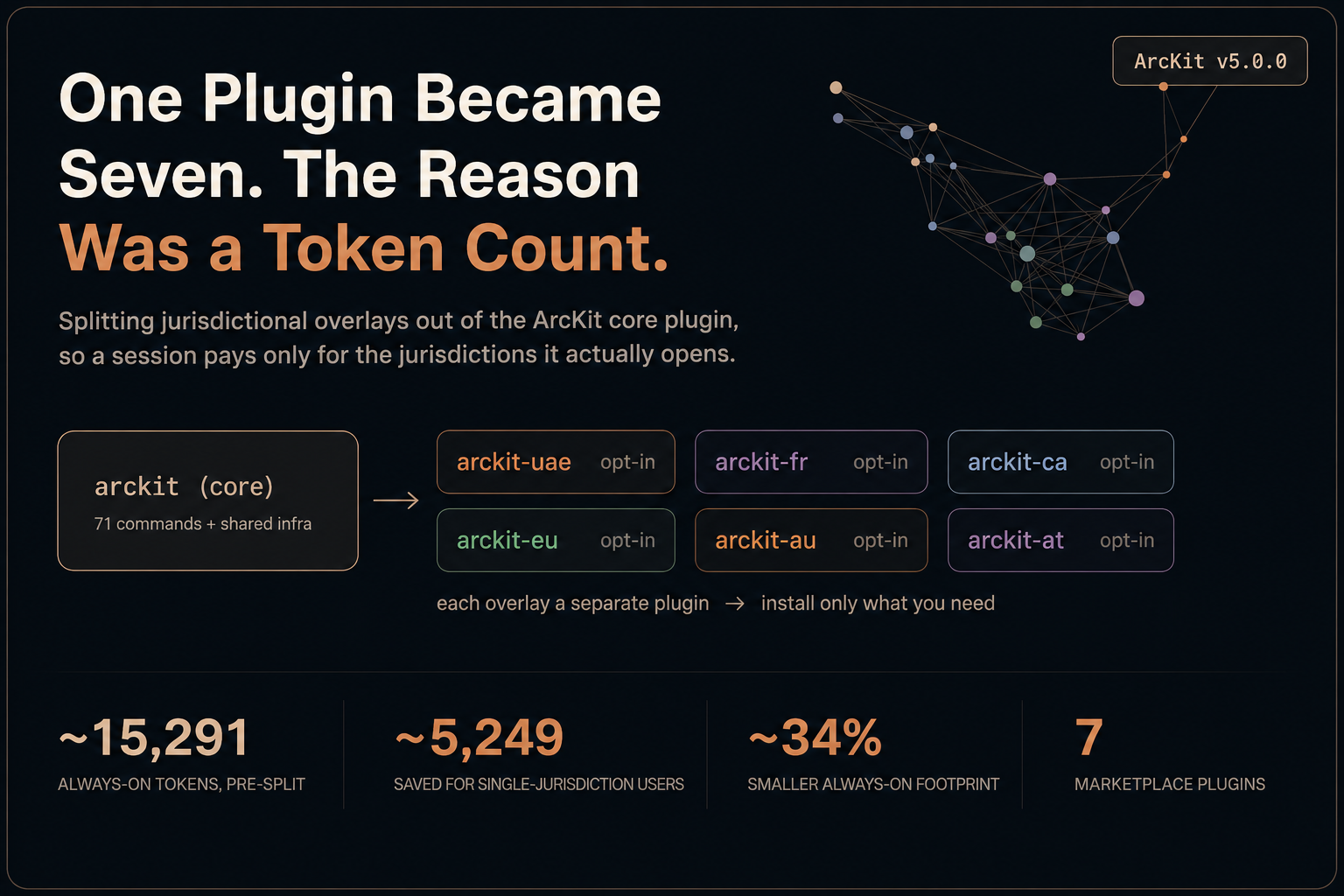
Every architecture decision has a number behind it. The number behind ArcKit v5.0.0 came from one command, claude plugin details, which reported that the old single-plugin ArcKit added roughly 15,000 tokens to every session before the user typed anything. A third of that was jurisdictional compliance for countries the user would never work in. This article reads that receipt in full: where the always-on cost goes, why agents dominate the core figure while overlay command descriptions cost three times what core commands do, and how splitting into seven marketplace plugins cut a single-jurisdiction user's always-on footprint by about 34 percent. It closes with an eight-step guide to splitting a monolithic plugin of your own.
Read article →
Technical
19 May 2026
The Leaf Node Problem: why your AI pilot is optimising the wrong thing
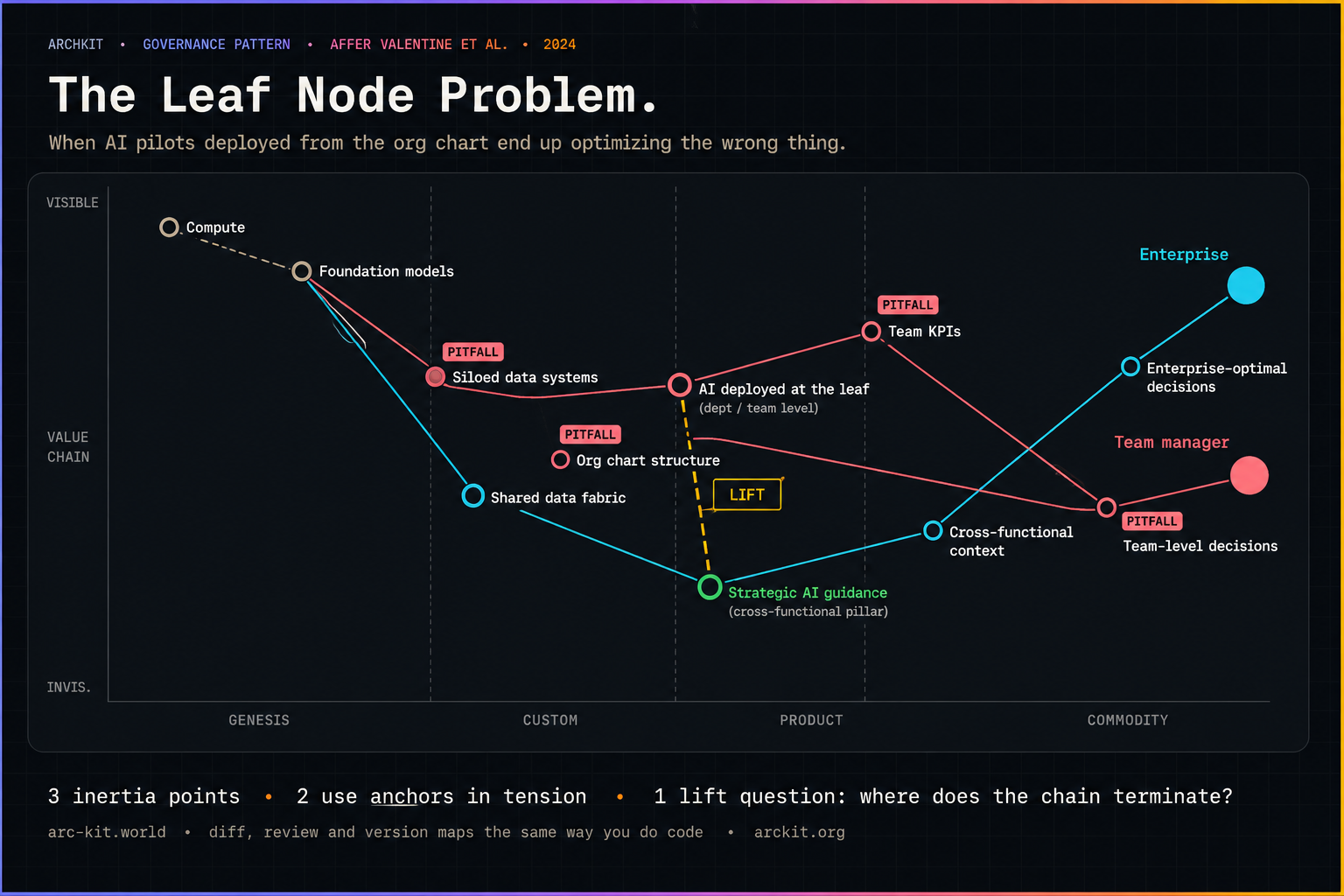
Most AI pilots in large organisations are funded by a team and accountable to a team. The team has KPIs. Six months later there is a write-up showing local improvement, the pilot is declared a success, and the enterprise outcome the company actually cares about does not move. Valentine et al. (2024) named the pattern; Gonzalez picked it up as Idea 10 of Organizing Intelligence at DeepMind. The architectural shorthand is the leaf node problem — AI tooling deployed along the org chart inherits the org chart's gravity, with three points of inertia (Team KPIs, the org chart itself, and siloed data schemas) pulling every pilot downward. Mapped on a Wardley Map, the lift is visible, and so is the cost.
Read article →
Technical
19 May 2026
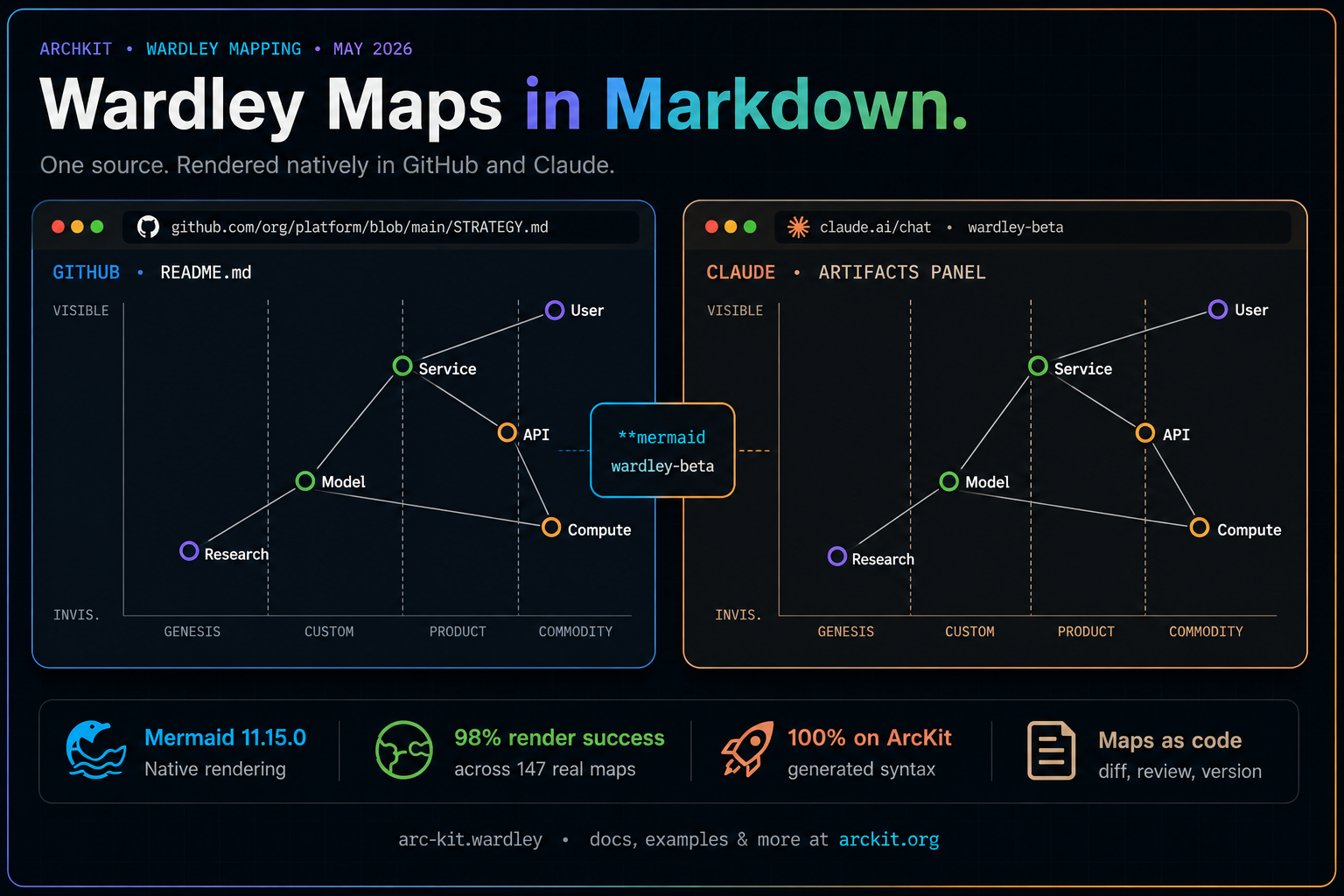
Your Wardley Maps belong in Git: what Mermaid support changes
For most of the last decade, Wardley Maps lived on a whiteboard, in a PNG screenshot in a deck, or on a third-party site buried in a wiki. Mermaid 11.15.0 finally makes wardley-beta stable enough to use in production, so GitHub renders maps natively in any markdown file and Claude renders them in the artifacts side panel. That combination quietly resolves the biggest practical problem with Wardley Mapping: keeping the map alive after the meeting. Maps go through code review, get versioned alongside the system they describe, appear where the work happens, and read and write the same way AI assistants already do.
Read article →
Release
18 May 2026
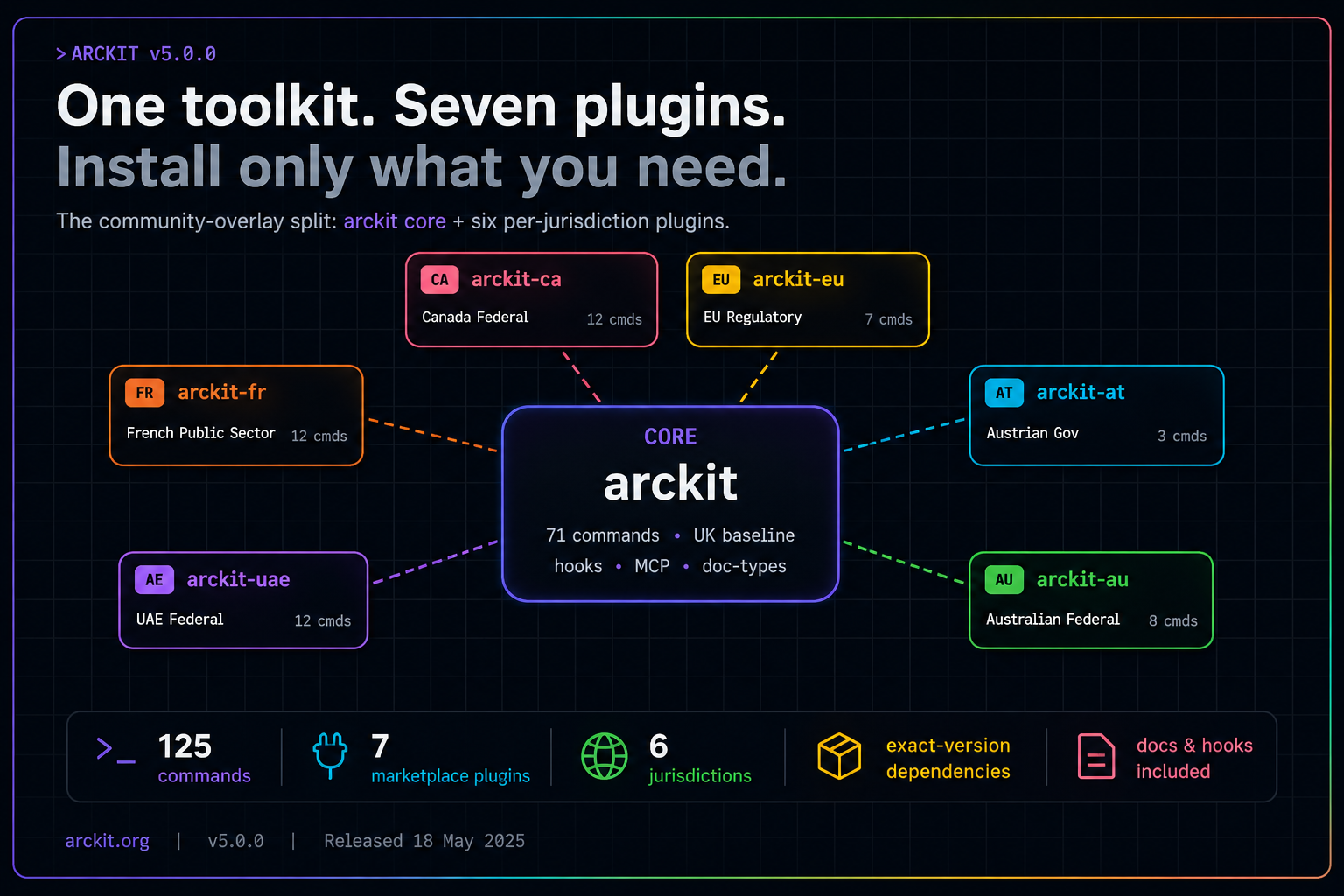
ArcKit v5.0.0: one toolkit, seven plugins, install only what you need
ArcKit v5.0.0 splits the monolithic plugin into seven marketplace plugins: an arckit core that ships the seventy-one official UK Government baseline commands plus six per-jurisdiction community overlays for the UAE, France, Canada, the EU, Austria and (new in v5) Australia. UK-only users get back around five thousand tokens of system-reminder bloat at every session start; multi-jurisdiction users install only the overlays they actually need; and the new dependencies field auto-installs core whenever you install an overlay.
Read article →
Launch
12 May 2026
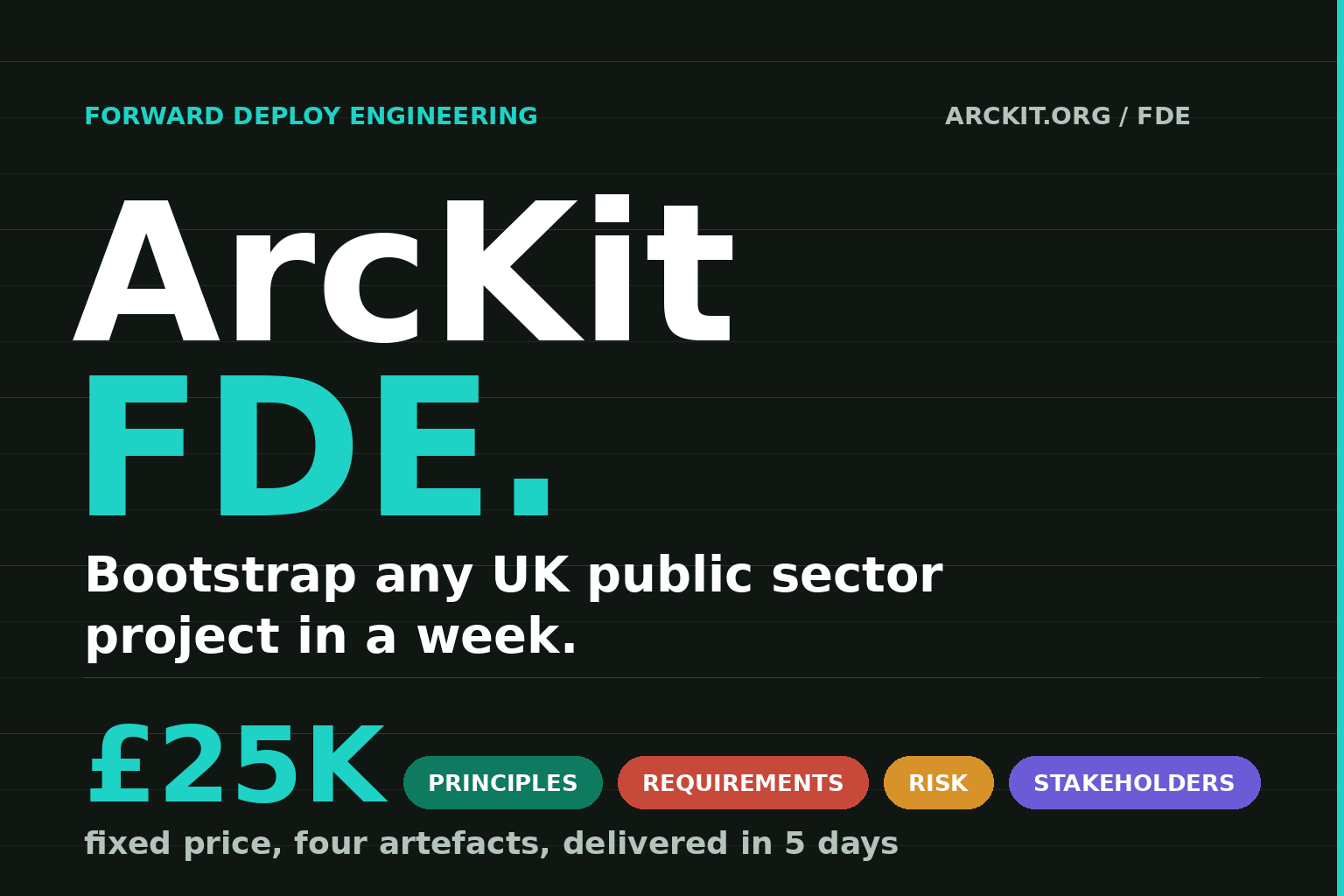
We are launching ArcKit FDE: embedded architects for UK public sector
Real agentic AI, small teams, accelerated programmes. Bootstrap any UK public sector project in a week, fixed price £25K for the four-artefact governance pack, with optional embedded follow-on after that. The name borrows from a category OpenAI just made explicit when they launched The OpenAI Deployment Company: not consultants, Forward Deployed Engineers. ArcKit FDE applies the model to UK public sector programmes, with 117 agentic AI commands on Claude Code compressing the governance, procurement and assurance evidence work that traditionally takes a Big 4 bench three months.
Read article →
Technical
6 May 2026
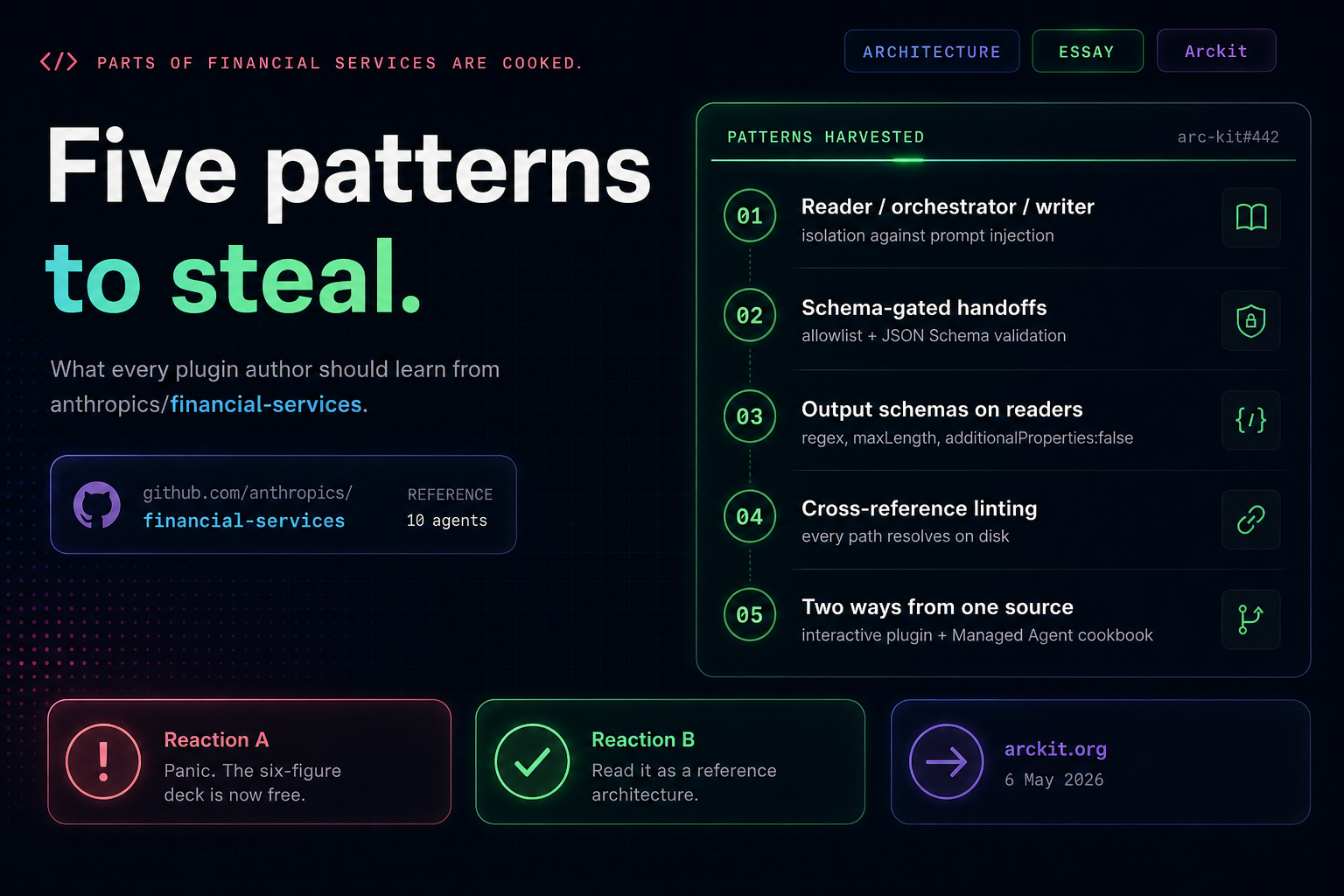
Five patterns to steal from anthropics/financial-services
Parts of the financial services sector are cooked, and you can date the moment fairly precisely. When Anthropic dropped their FSI reference plugins into a public GitHub repo, two reactions landed in our inbox: panic, and engineering. Here is the engineering read — reader/orchestrator/writer isolation, schema-gated handoffs, output schemas with regex constraints, cross-reference linting, and the two-ways-from-one-source deployment pattern, all extracted in arc-kit#442.
Read article →
Community
3 May 2026
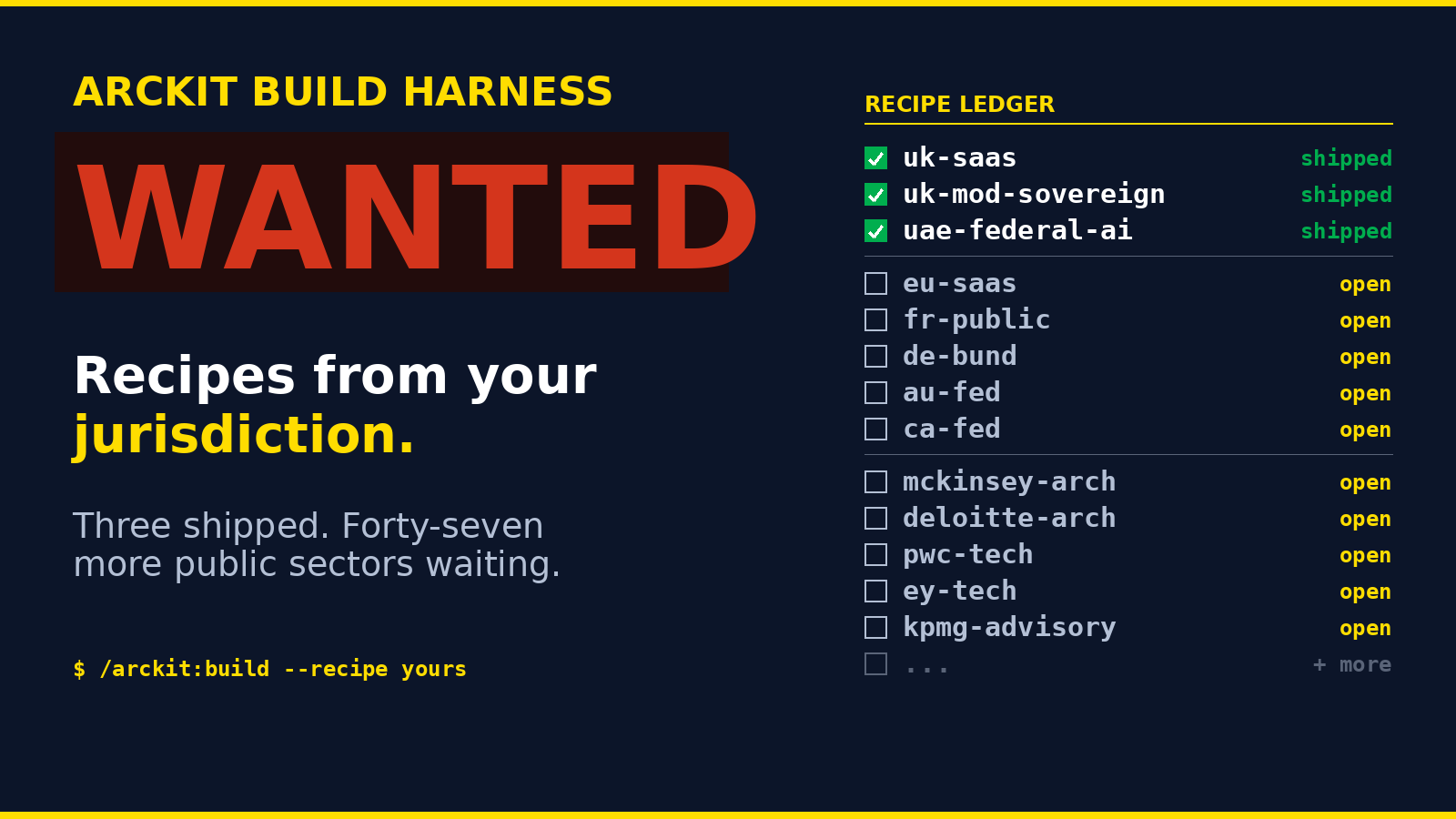
Wanted: /arckit:build recipes for your jurisdiction
Three recipes ship with v4.13.1: uk-saas, uk-mod-sovereign, uae-federal-ai. That's roughly 0.5 per cent of the world's public sectors. EU, Australia, Canada, Germany, France, Singapore — your jurisdiction's recipe could ship with v4.14. And a separate category: Big 4 / MBB / system integrator firm-style governance bundles (mckinsey-arch, deloitte-arch, pwc-tech, …) — composition, not endorsement.
Read article →
Release
3 May 2026
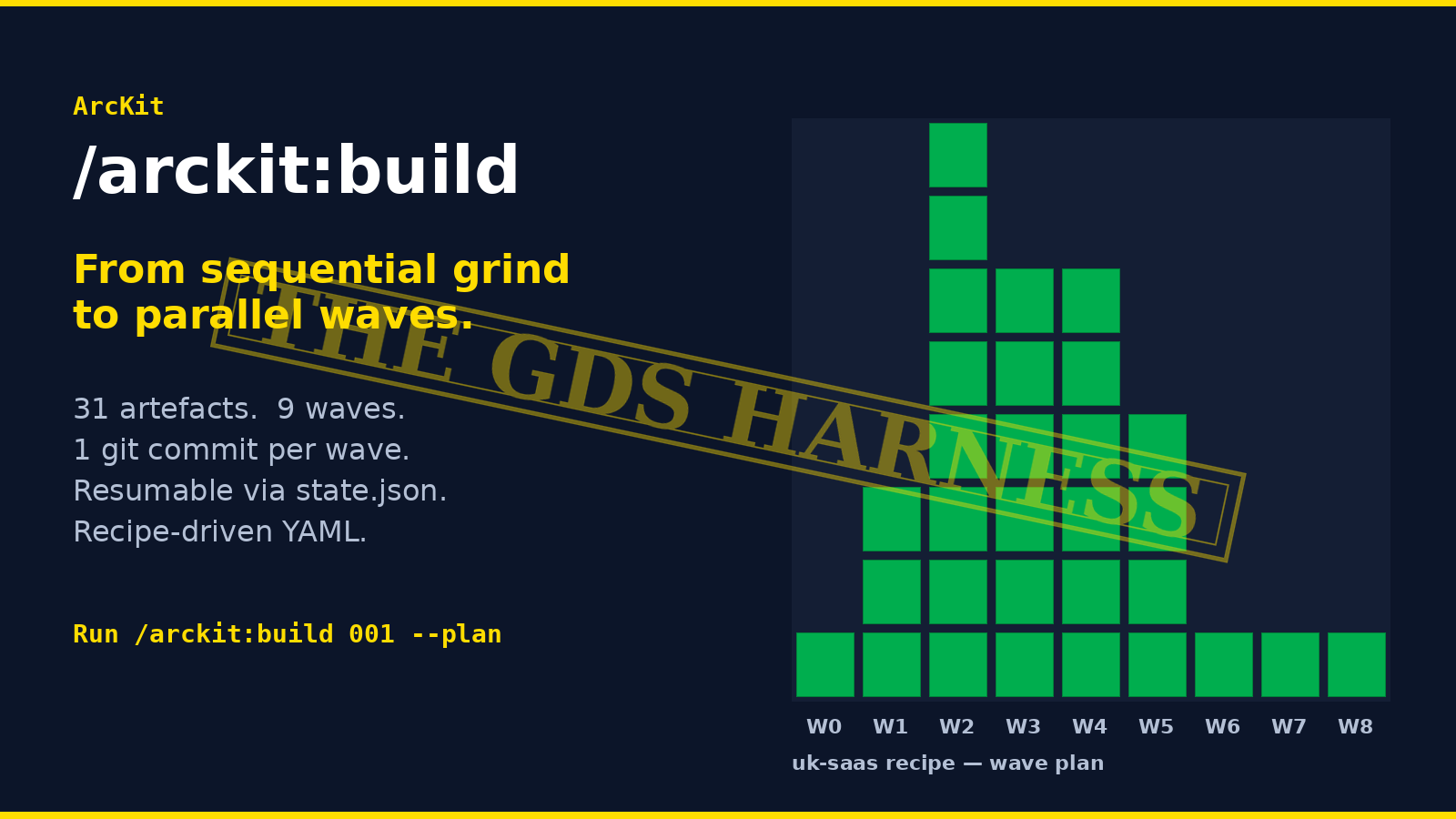
ArcKit v4.13.0: The Build Harness — Building a full architecture in one Claude Code session. AKA The GDS Harness
A new /arckit:build command orchestrates parallel /arckit:* artefact generation via subagent isolation. YAML recipes drive the wave plan, state.json makes the run resumable, and the validate-arc-filename hook handles path allocation. Thirty-one artefacts in under thirty minutes, one git commit per wave.
Read article →
Essay
3 May 2026
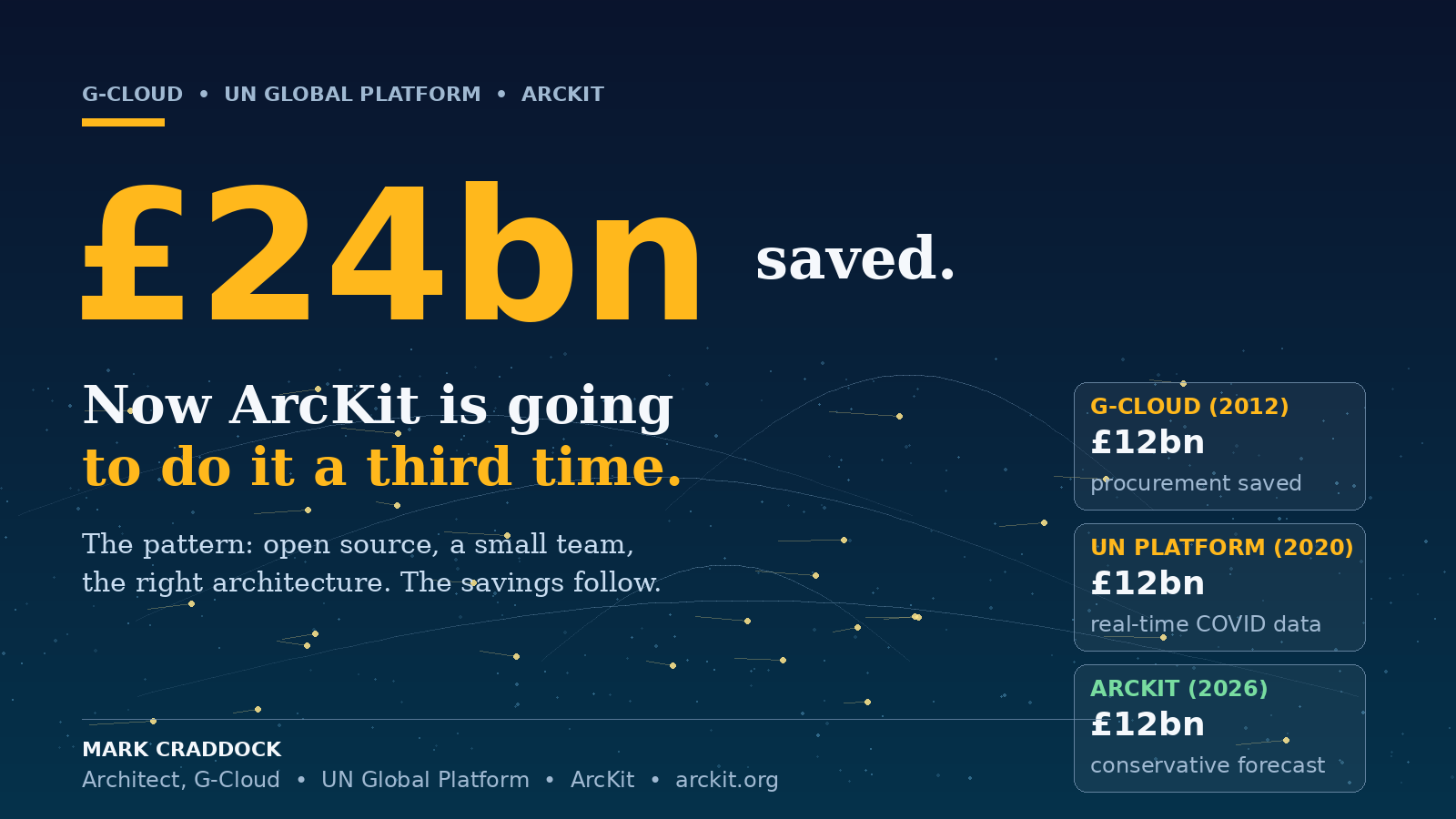
I have saved the UK economy £24 billion. ArcKit is the third time.
G-Cloud saved the UK around £12bn in procurement. The UN Global Platform saved another £12bn through real-time COVID economic indicators fed to the Treasury and Bank of England. The same playbook applied to enterprise architecture is the next £12bn.
Read article →
Essay
1 May 2026
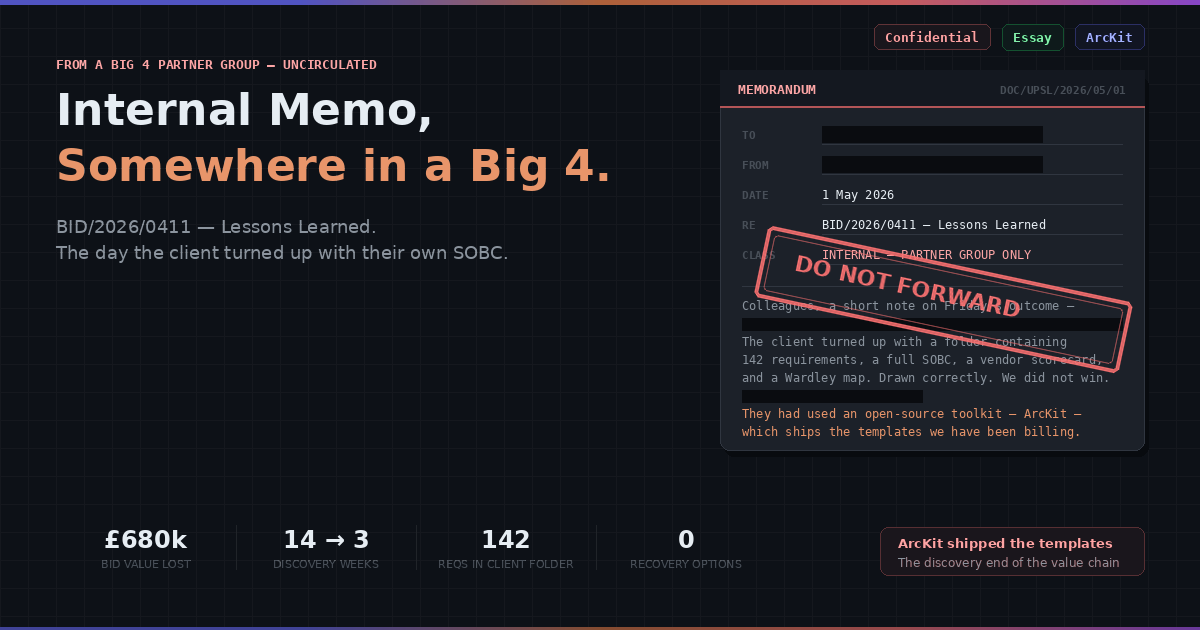
Internal Memo, Somewhere in a Big 4 Consulting Company
A fictional partner-group memo on a £680k Phase 0 bid lost to two civil servants and a contractor with a long weekend and ArcKit. What the in-house pack contained, why it was good enough, and what the practice should do about it.
Read article →
Release
30 April 2026
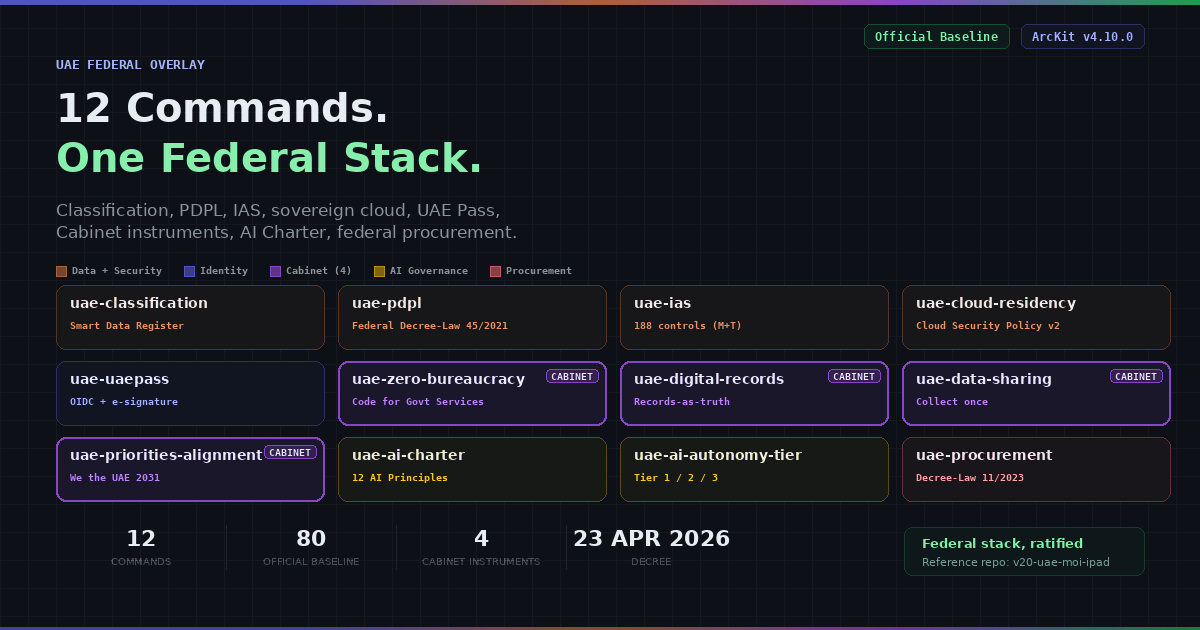
ArcKit v4.10: 12 UAE Federal Commands, Community Overlay
Twelve community-contributed commands covering the UAE federal regulatory and digital-government stack. The release walkthrough: PDPL, IAS, sovereign cloud residency, UAE Pass, the four Cabinet instruments, AI Charter, autonomy tier, federal procurement. Solo-maintained today; recruiting a UAE domain co-maintainer before any official-tier promotion.
Read article →
Essay
30 April 2026
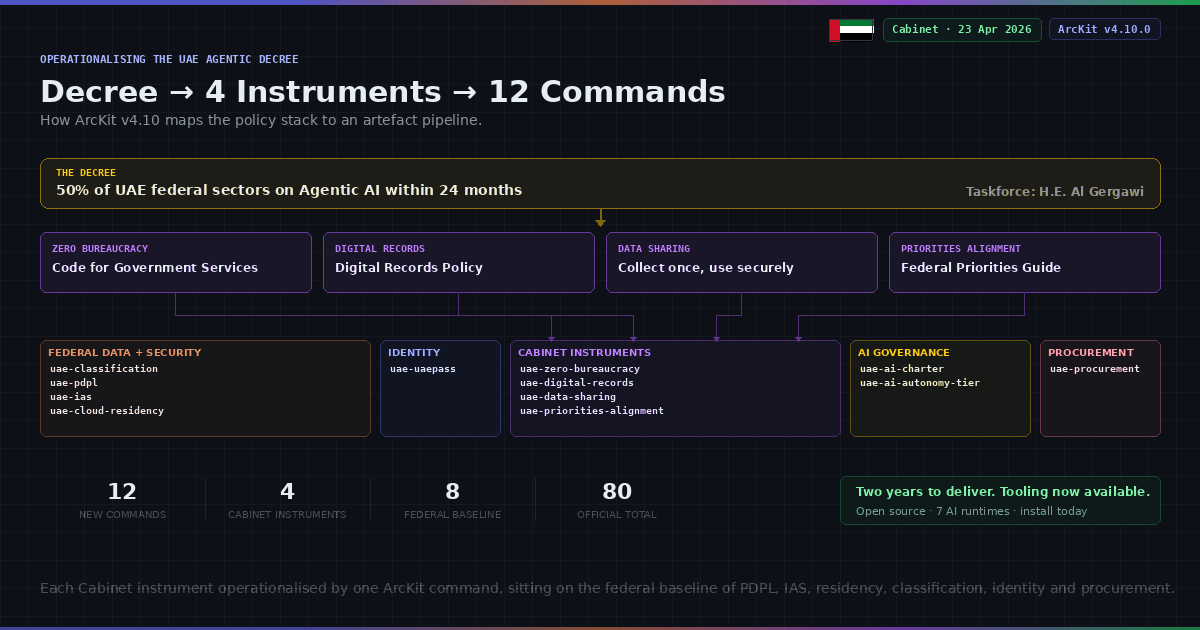
How ArcKit v4.10 Accelerates the UAE's Federal Agentic Decree
Policy-audience essay mapping the 23 April Cabinet decree, the four governance instruments, and the federal regulatory baseline directly onto the 12 new uae-* commands. One command per instrument; eight more for the federal baseline; two for AI governance; one for procurement.
Read article →
Guide
30 April 2026
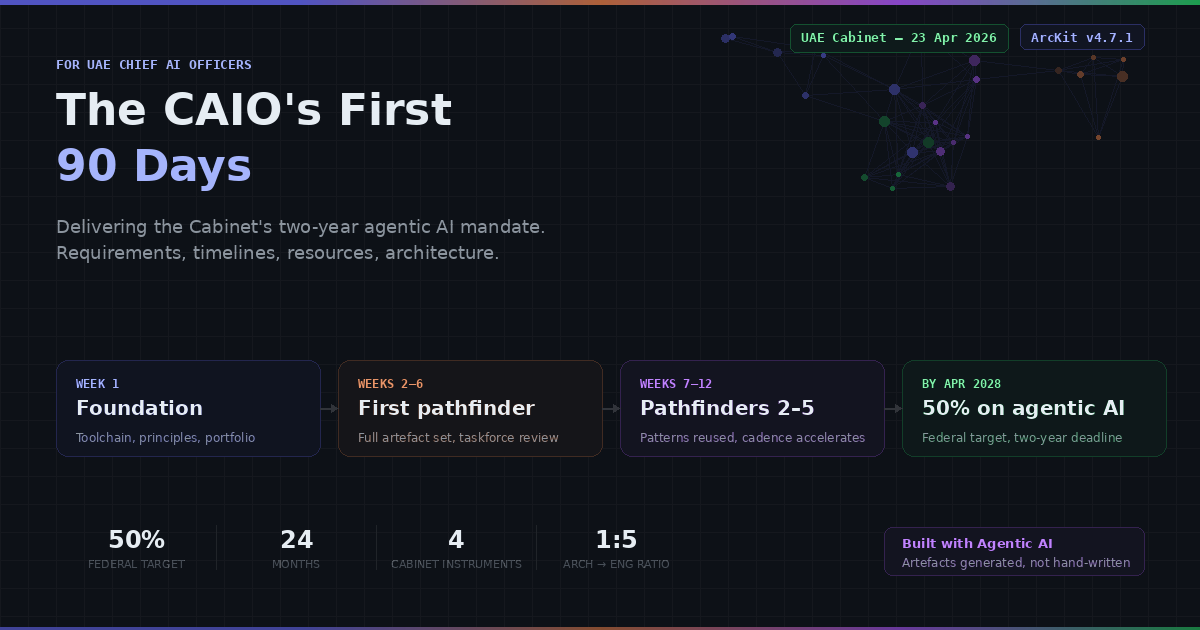
The CAIO's First 90 Days: Delivering the UAE Cabinet Agentic AI Mandate
For UAE Chief AI Officers under the Cabinet's two-year deadline: what to produce, what timeline is achievable, what team and budget you will need, and what architecture stack the artefacts have to fit. Concrete week-one actions and a credible cadence to month twenty-four.
Read article →
Guide
30 April 2026
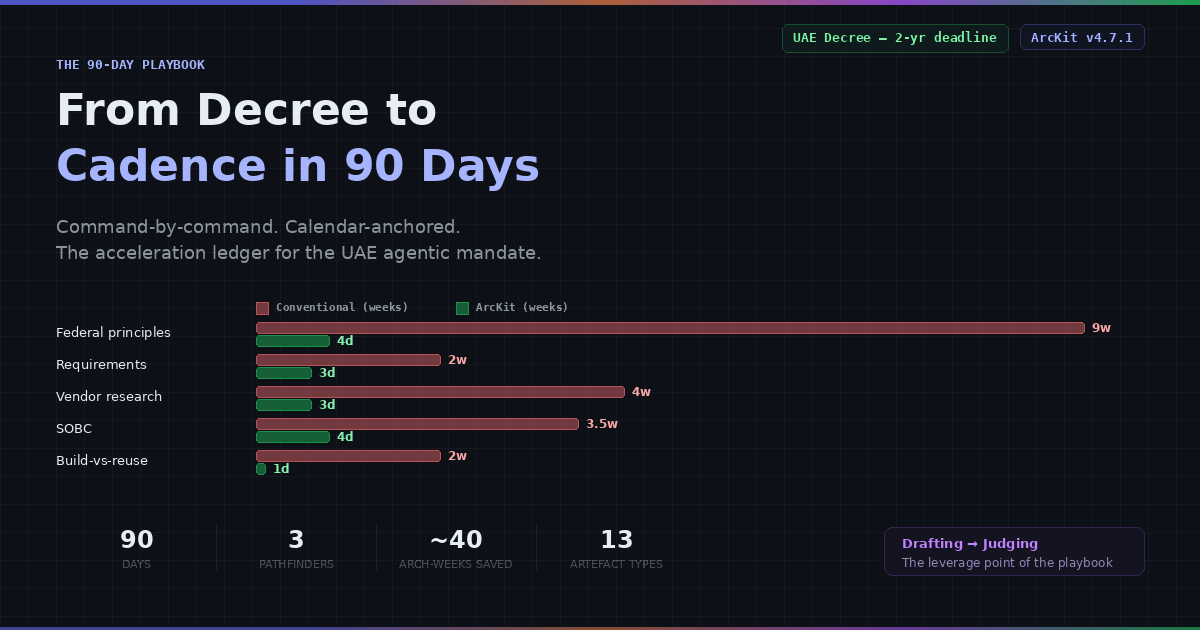
The UAE Agentic Decree: A 90-Day ArcKit Playbook
Command-by-command, calendar-anchored playbook for the first ninety days under the UAE Cabinet's agentic decree. The acceleration ledger comparing conventional architect-weeks against ArcKit-weeks per artefact, with the working that makes the two-year deadline arithmetically possible.
Read article →
Essay
30 April 2026
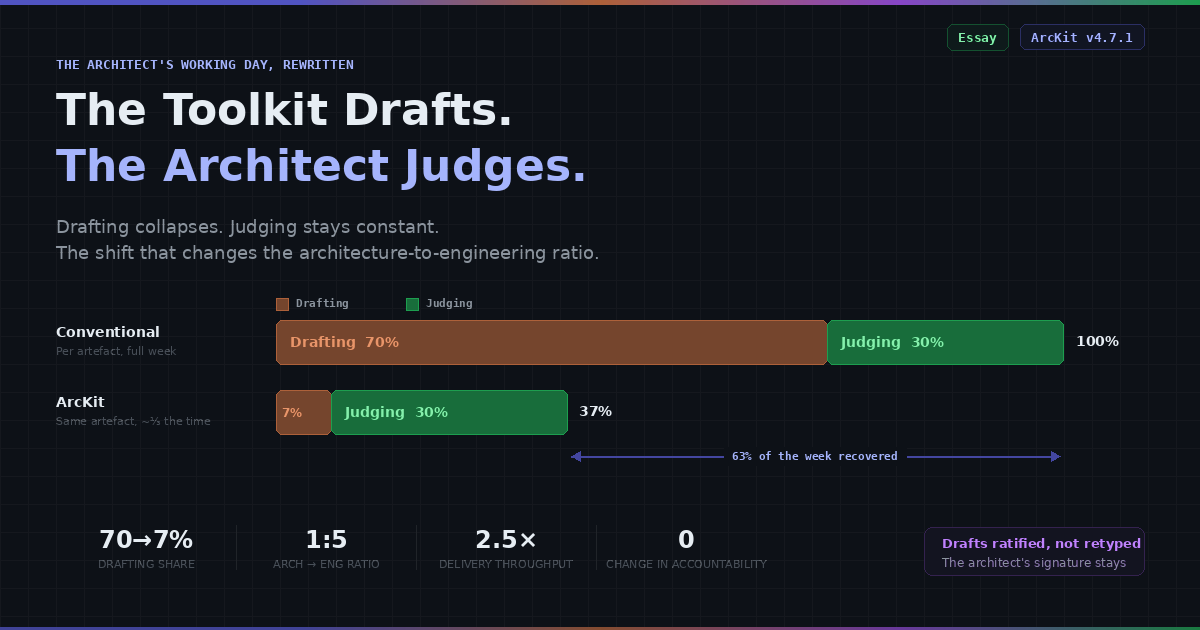
The Toolkit Drafts. The Architect Judges.
Why the architect's working day under agentic tooling shifts from drafting to judging, what that does to the architect-to-engineer ratio, and the two failure modes that quietly defeat the productivity case if the calibration is wrong.
Read article →
Essay
28 April 2026
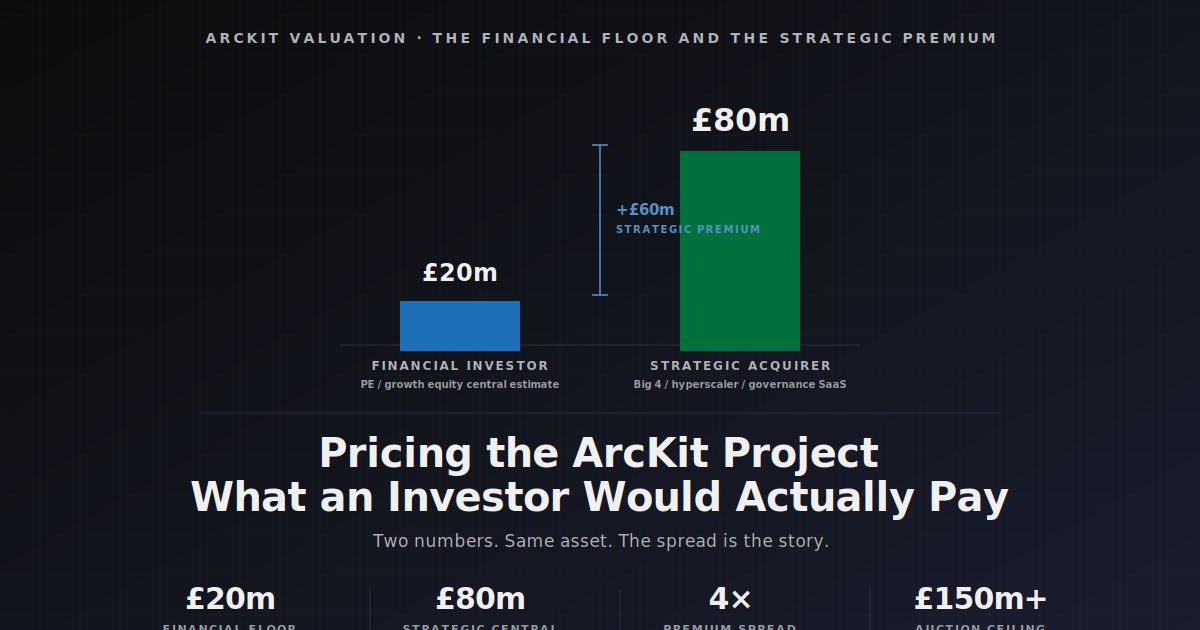
Pricing the ArcKit Project: What Would an Investor Actually Pay?
A defensible valuation range for ArcKit today: ~£20m for a financial investor, ~£80m for a strategic acquirer, with the working from comparables (Vanta, Drata, OneTrust, HashiCorp) shown in full.
Read article →
Essay
27 April 2026
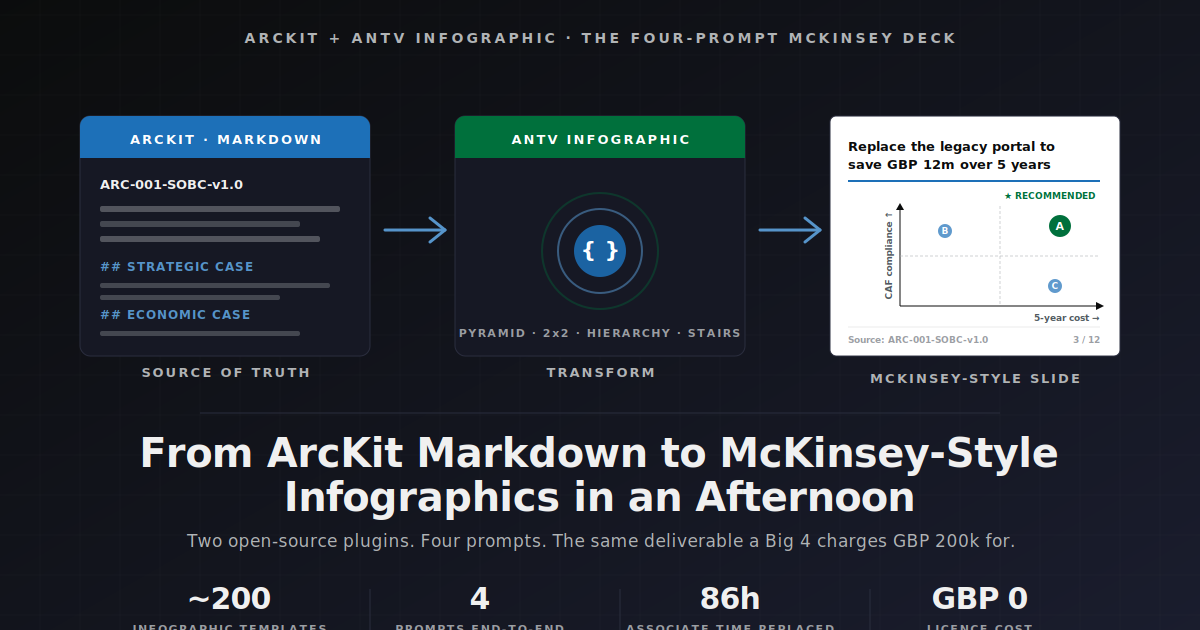
From ArcKit to McKinsey-Style Infographics in an Afternoon
AntV Infographic and the end of the £200k visual wrap: how ArcKit artifacts become action-titled, Pyramid-Principle decks without the partner-rate consulting layer.
Read article →
Guide
22 April 2026
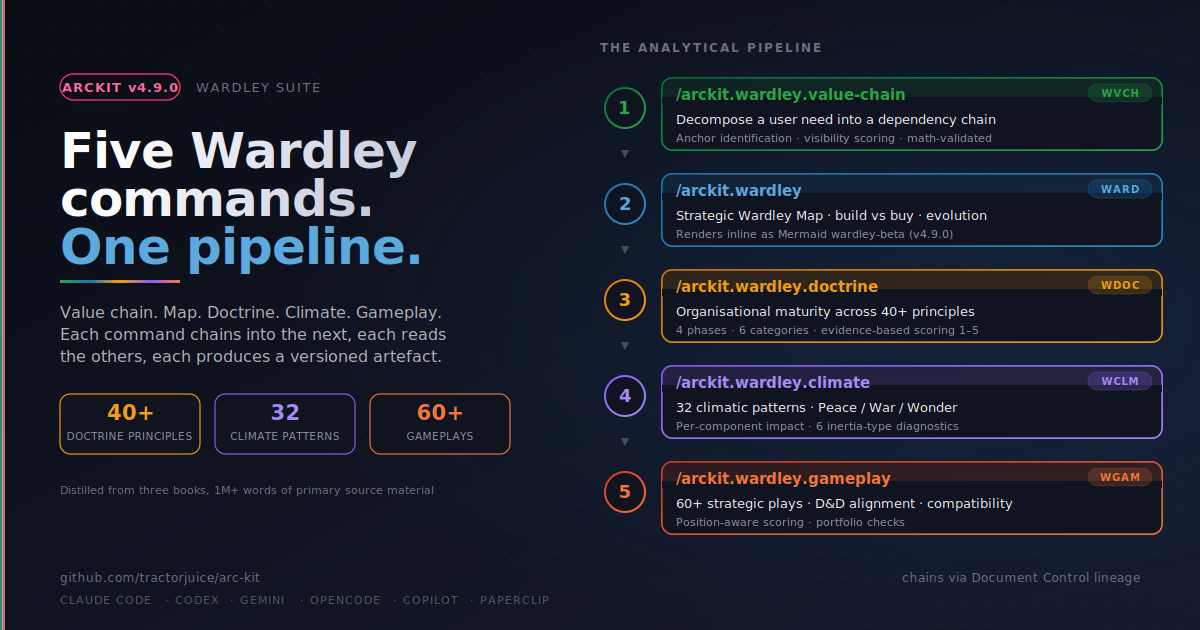
The Five Wardley Commands in ArcKit
A command-by-command walkthrough of ArcKit's Wardley Mapping suite: value-chain, wardley, doctrine, climate, and gameplay — what each does, when to run it, and how they chain.
Read article →
Release
22 April 2026
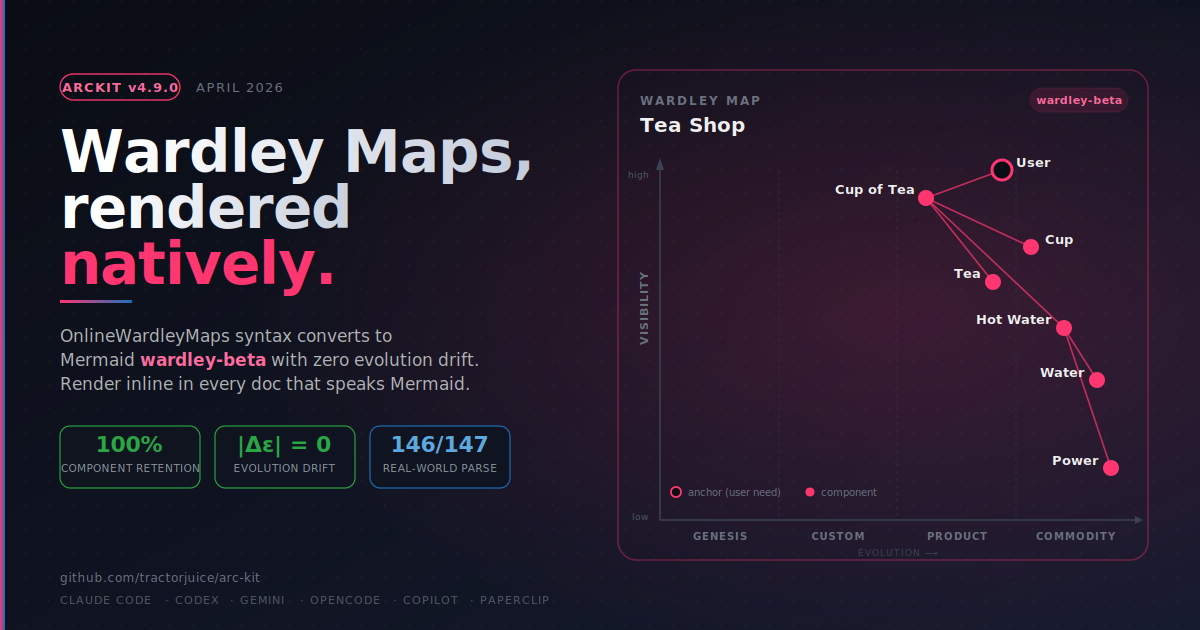
ArcKit 4.9.0: Wardley Maps Render Natively
Mermaid 11.14.0 brings a wardley-beta diagram type, and ArcKit adopts it everywhere. 100% conversion fidelity across 147 real-world maps, zero evolution drift.
Read article →
Essay
20 April 2026
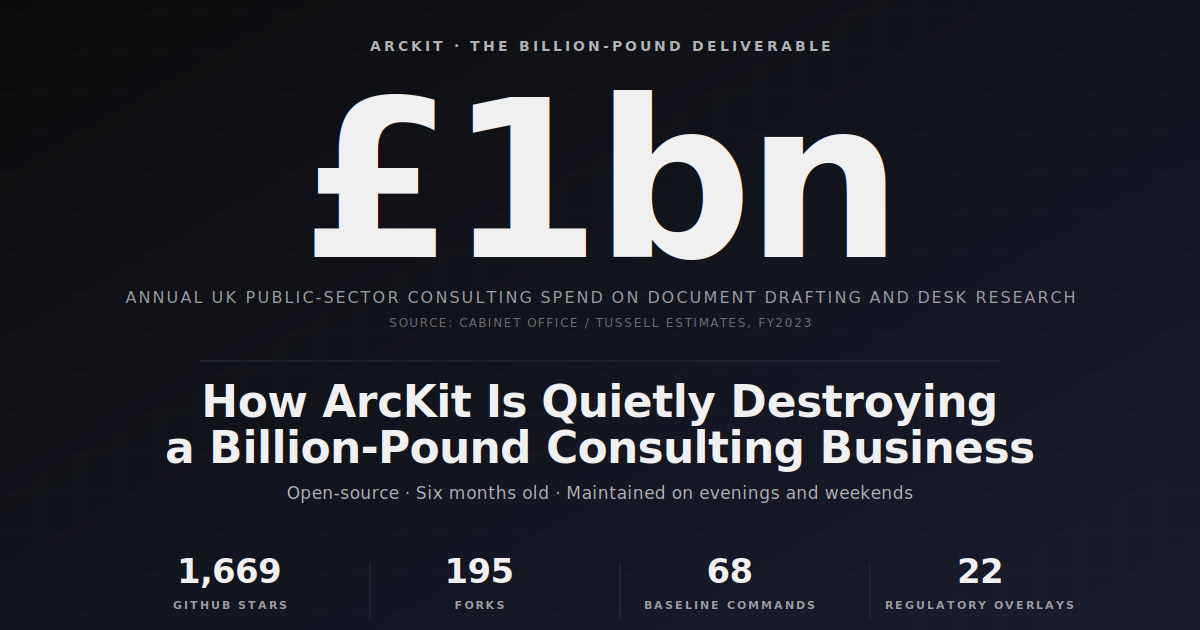
How ArcKit Is Quietly Destroying a Billion-Pound Consulting Business
For twenty years UK public-sector transformation has run on a Big 4 / MBB engine that ships a £250k–£2m PDF six months later. ArcKit makes the pipeline that produced it unnecessary — not the work itself, the pipeline.
Read article →
Release
20 April 2026
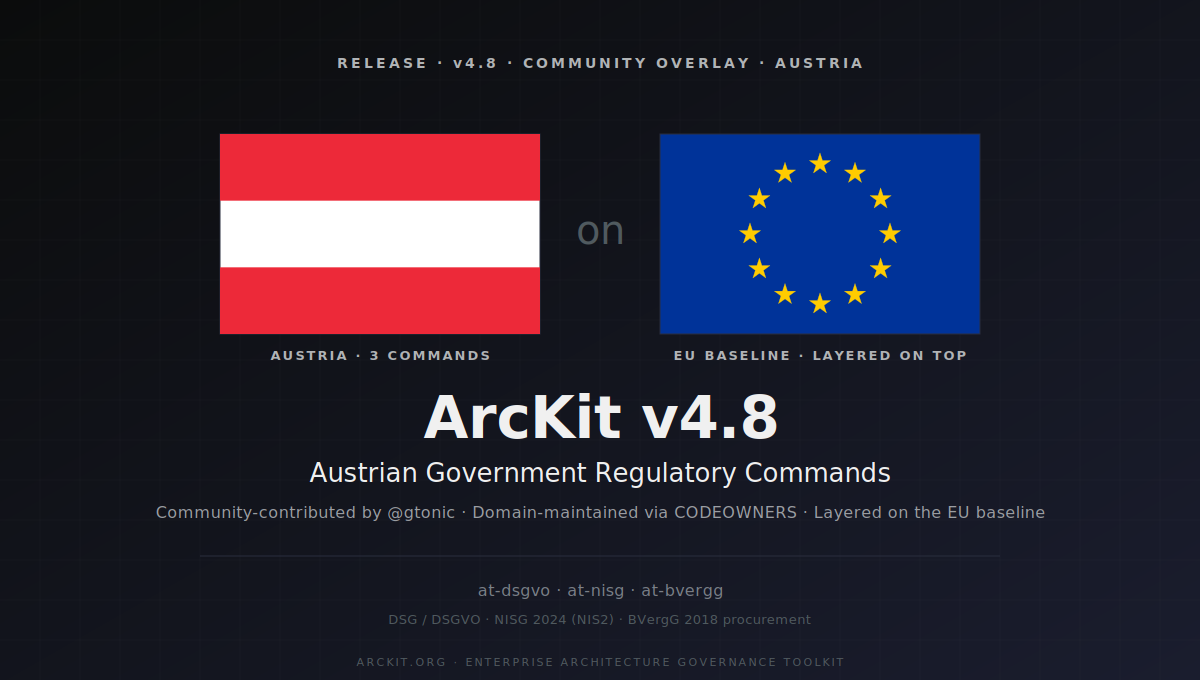
What You Can Now Do in Austria with ArcKit v4.8
Three Austrian regulatory commands: DSG / DSGVO assessment, NISG (NIS2) compliance, and BVergG 2018 procurement documentation — a community-maintained overlay.
Read article →
Release
19 April 2026
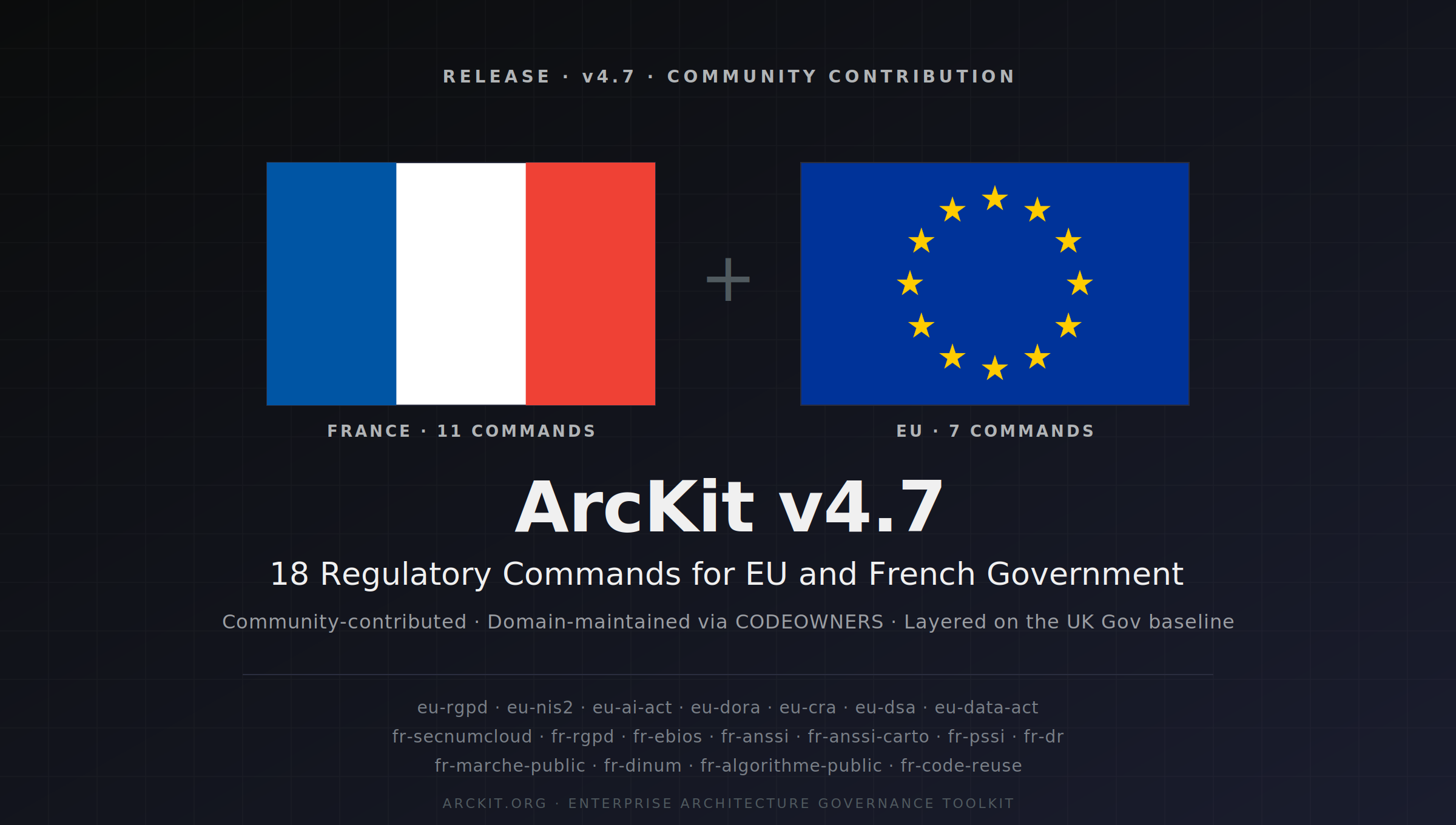
ArcKit v4.7: 18 EU and French Regulatory Commands
A community-contributed overlay covering GDPR, NIS2, DORA, EU AI Act, CRA, DSA plus French ANSSI, CNIL, and the aDRI IRN self-assessment.
Read article →
Milestone
19 April 2026
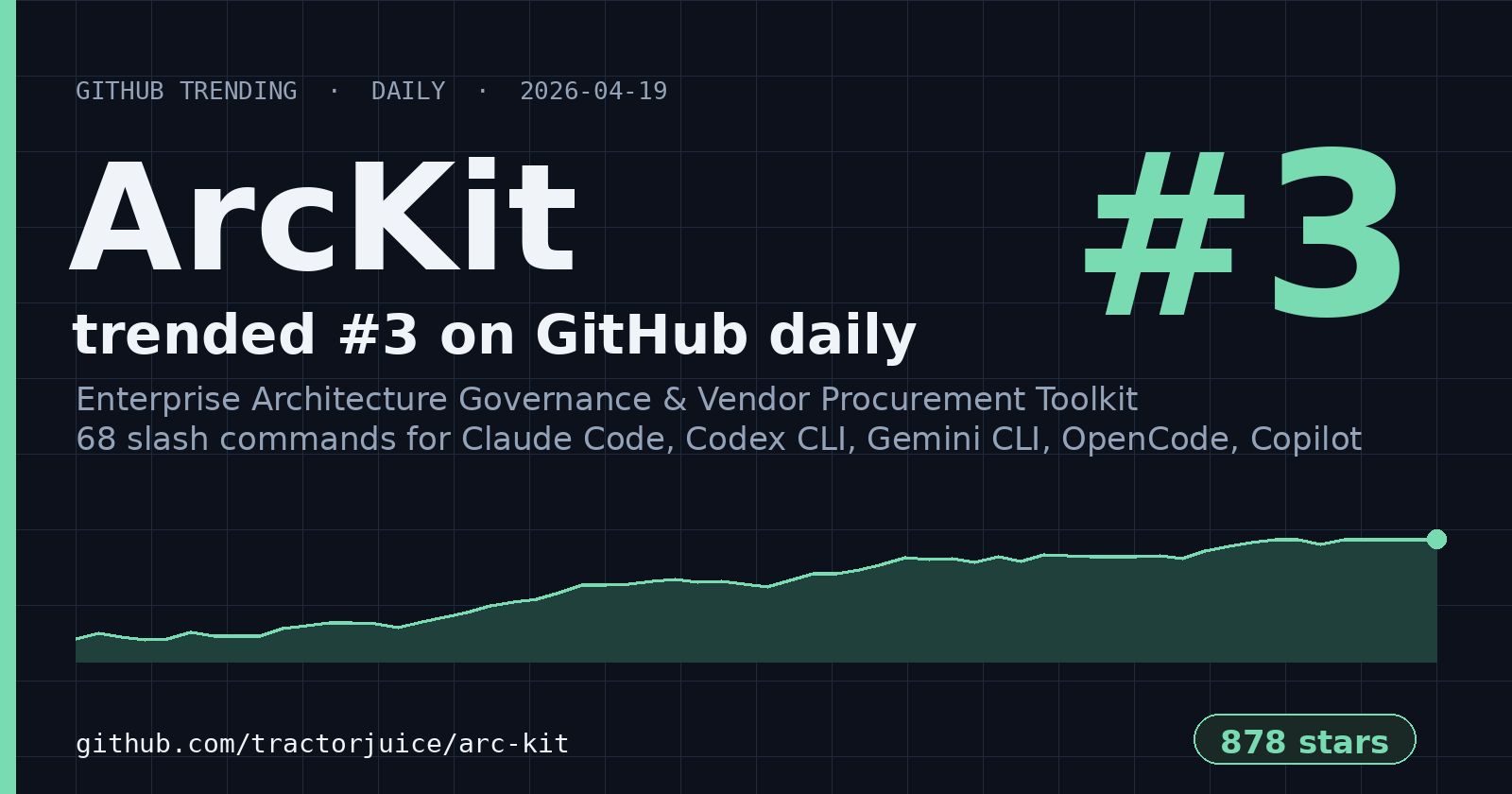
Why an EA Toolkit is Trending on GitHub in 2026
Notes on the day ArcKit hit GitHub Trending, what drove it, and what it signals about enterprise architecture tooling in the AI era.
Read article →
Release
7 April 2026
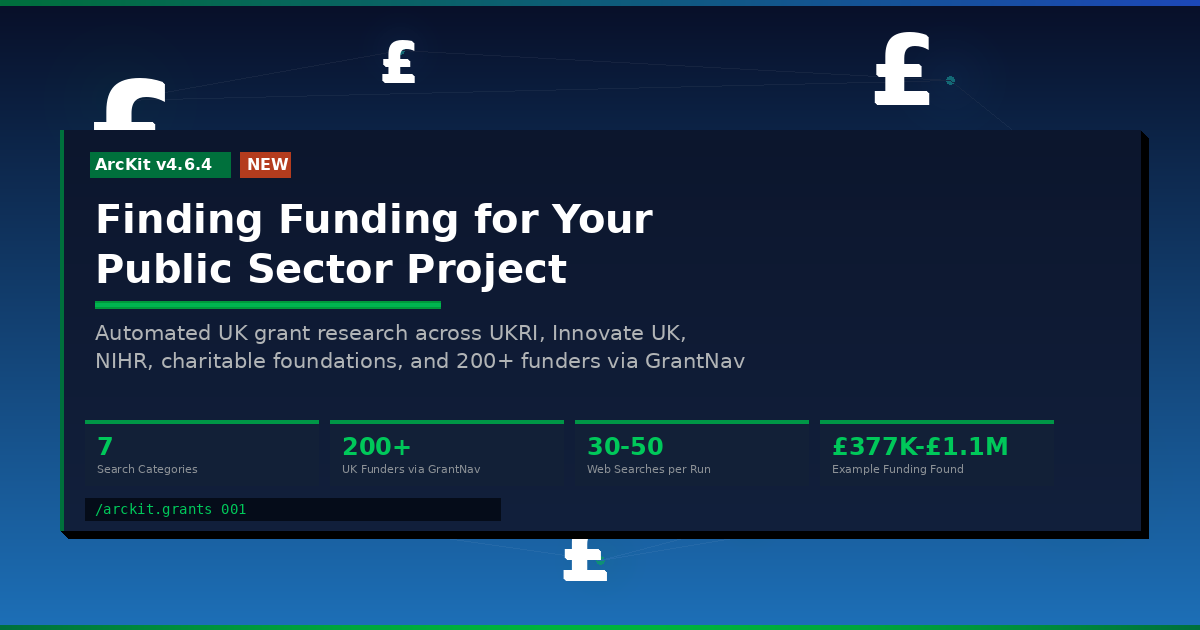
Finding UK Funding for Public Sector Projects
How the /arckit:grants command automates UK grant research, innovation funding, and accelerator discovery directly from your architecture context.
Read article →
ArcKit v4.6.4
Release
7 April 2026
Automated UK Funding Research with the Grants Command
A technical look at the /arckit:grants command: how the agent discovers funding sources, scores relevance, and generates the GRNT artefact.
Read article →
Release
23 March 2026
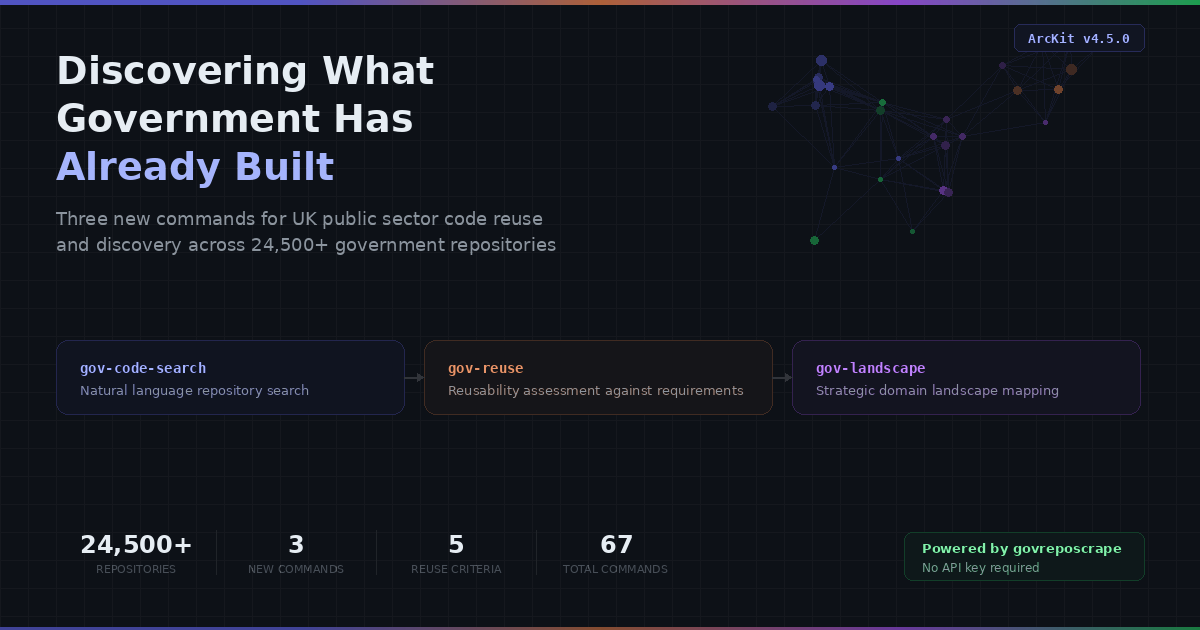
Discovering What Government Has Already Built
Three new commands for UK public-sector code reuse using the govreposcrape MCP server: gov-reuse, gov-code-search, and gov-landscape.
Read article →
Technical
18 March 2026
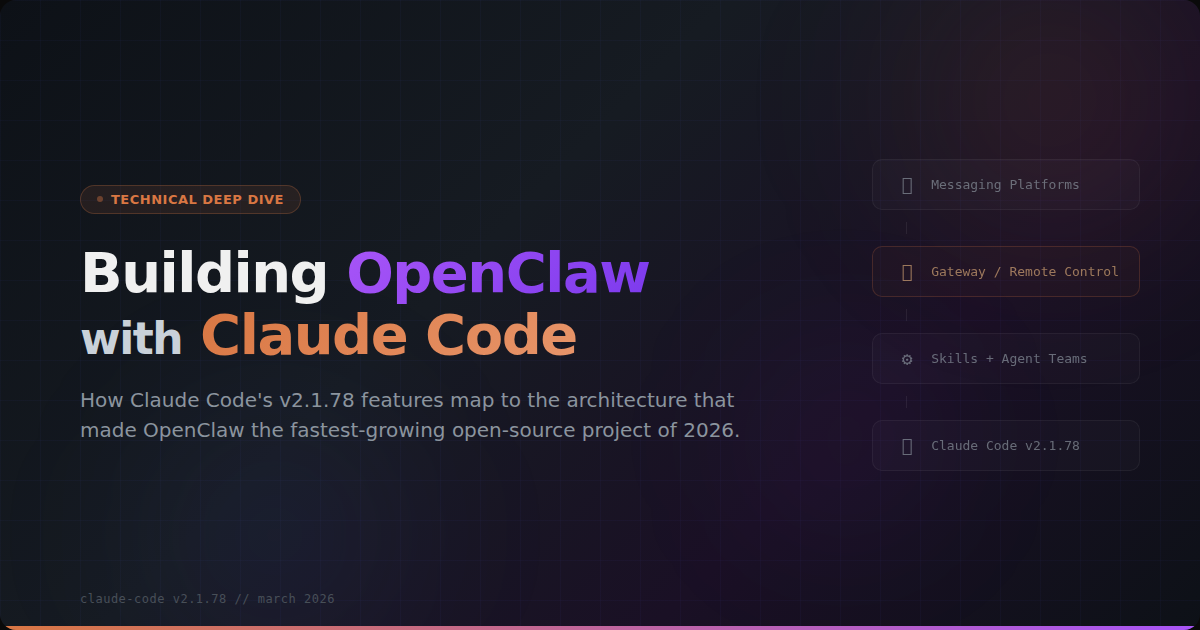
Building ClaudeClaw: Autonomous Agents on Claude Code
Engineering notes on building an OpenClaw-style autonomous agent system on top of Claude Code — agent orchestration, memory, and tool routing.
Read article →
Release
16 March 2026
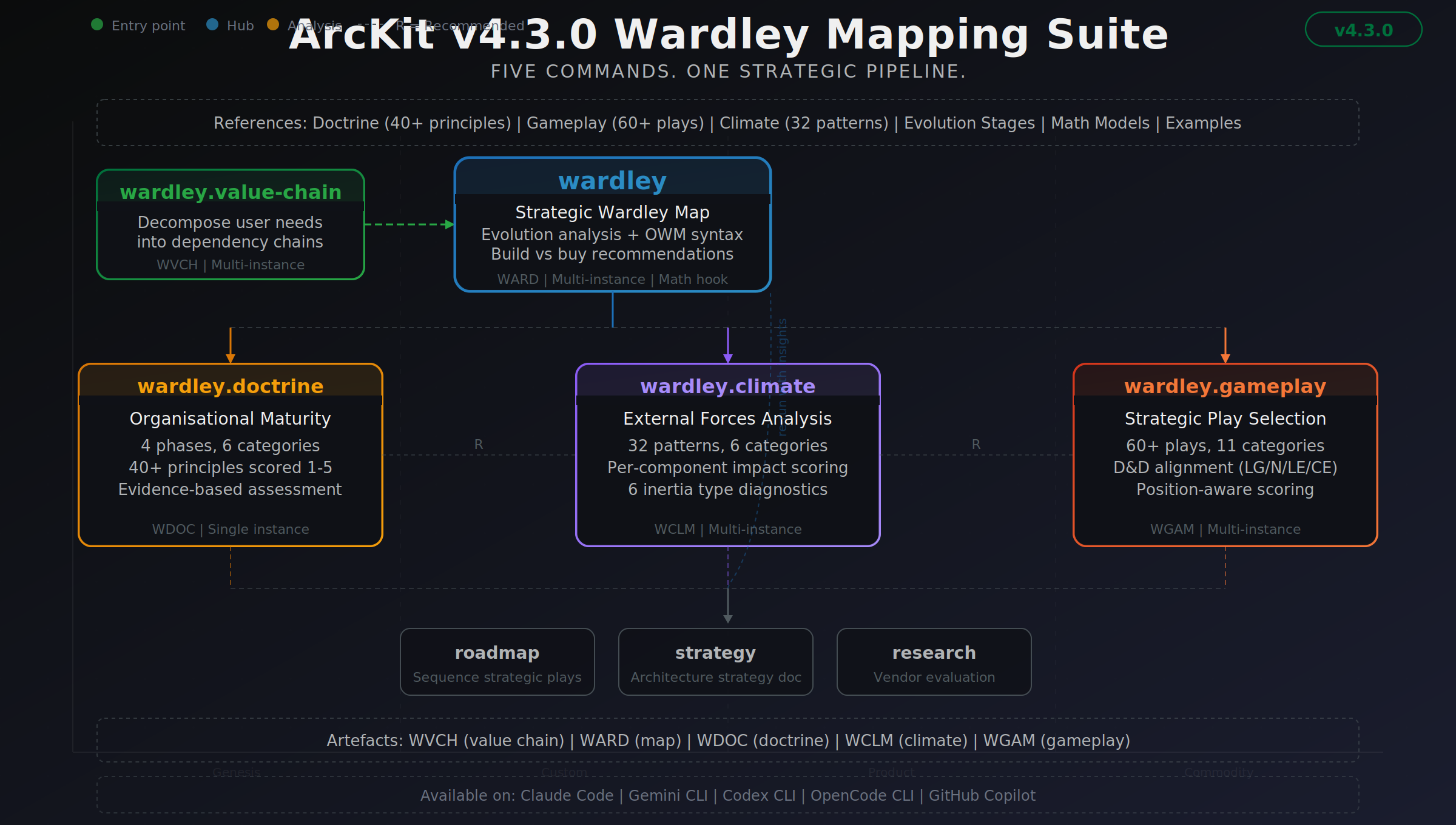
ArcKit v4.3.0: Complete Wardley Mapping Suite
A five-command pipeline for AI-assisted strategic architecture, distilled from three Wardley Mapping books and 1M+ words of primary source material.
Read article →
Release
12 March 2026
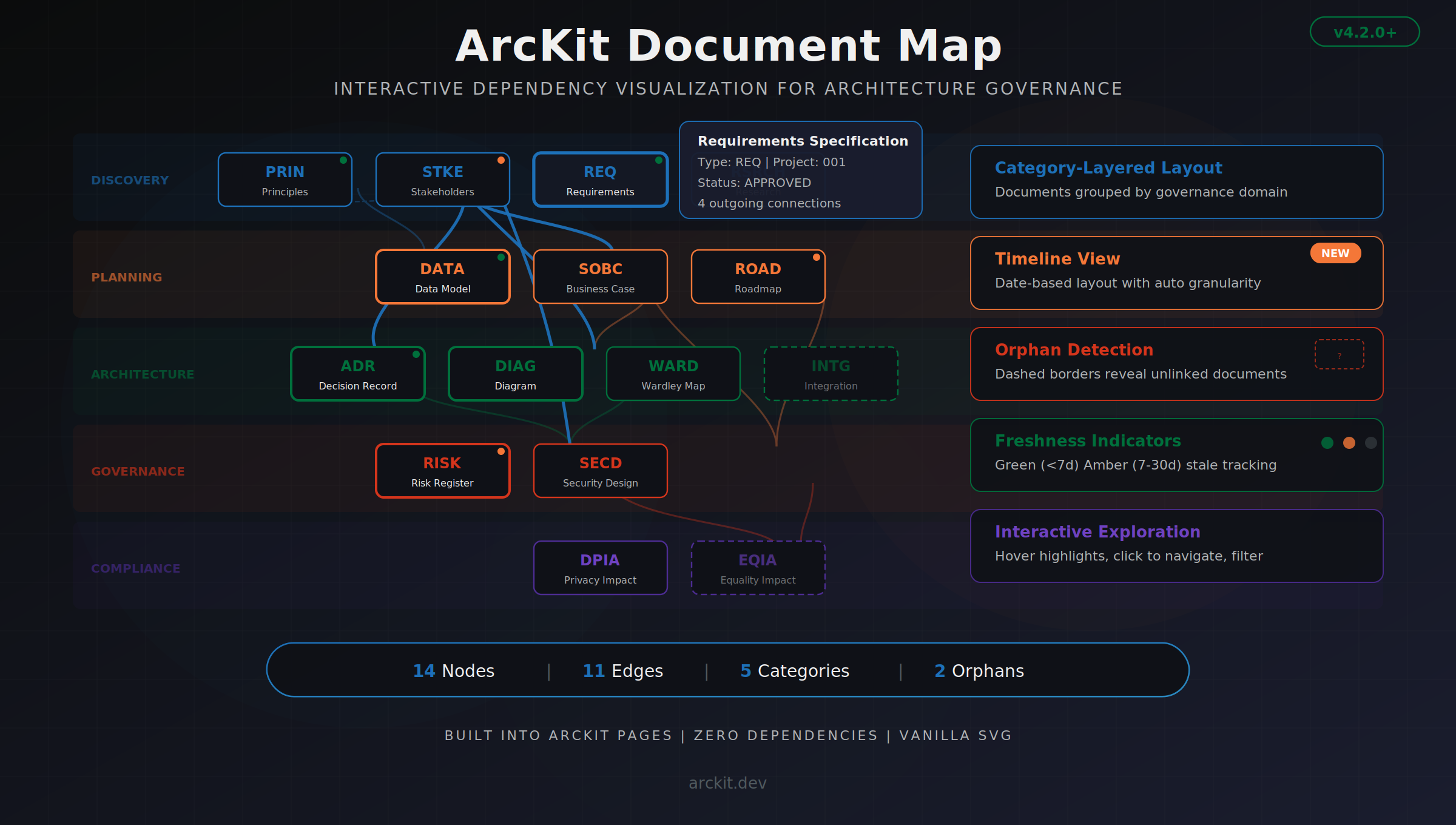
Your Architecture Documents Are Connected
ArcKit now auto-generates an interactive map showing how your requirements, stakeholders, risks, ADRs, and decisions relate across the artefact chain.
Read article →
Release
11 March 2026
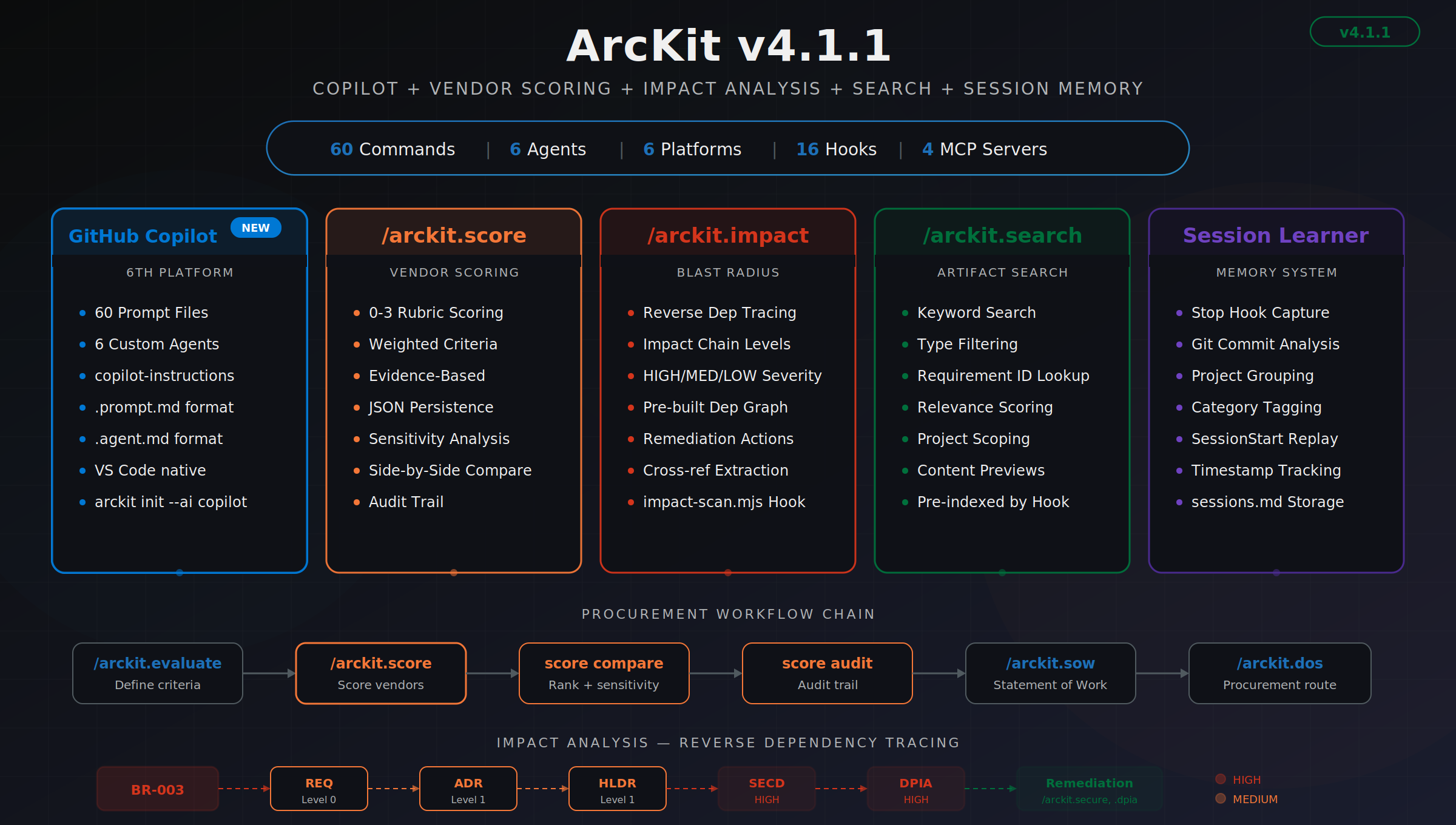
ArcKit v4.1.1: Copilot, Vendor Scoring, Blast Radius
GitHub Copilot extension, weighted vendor-scoring across procurement criteria, and blast-radius analysis for architecture decisions.
Read article →
Release
8 March 2026
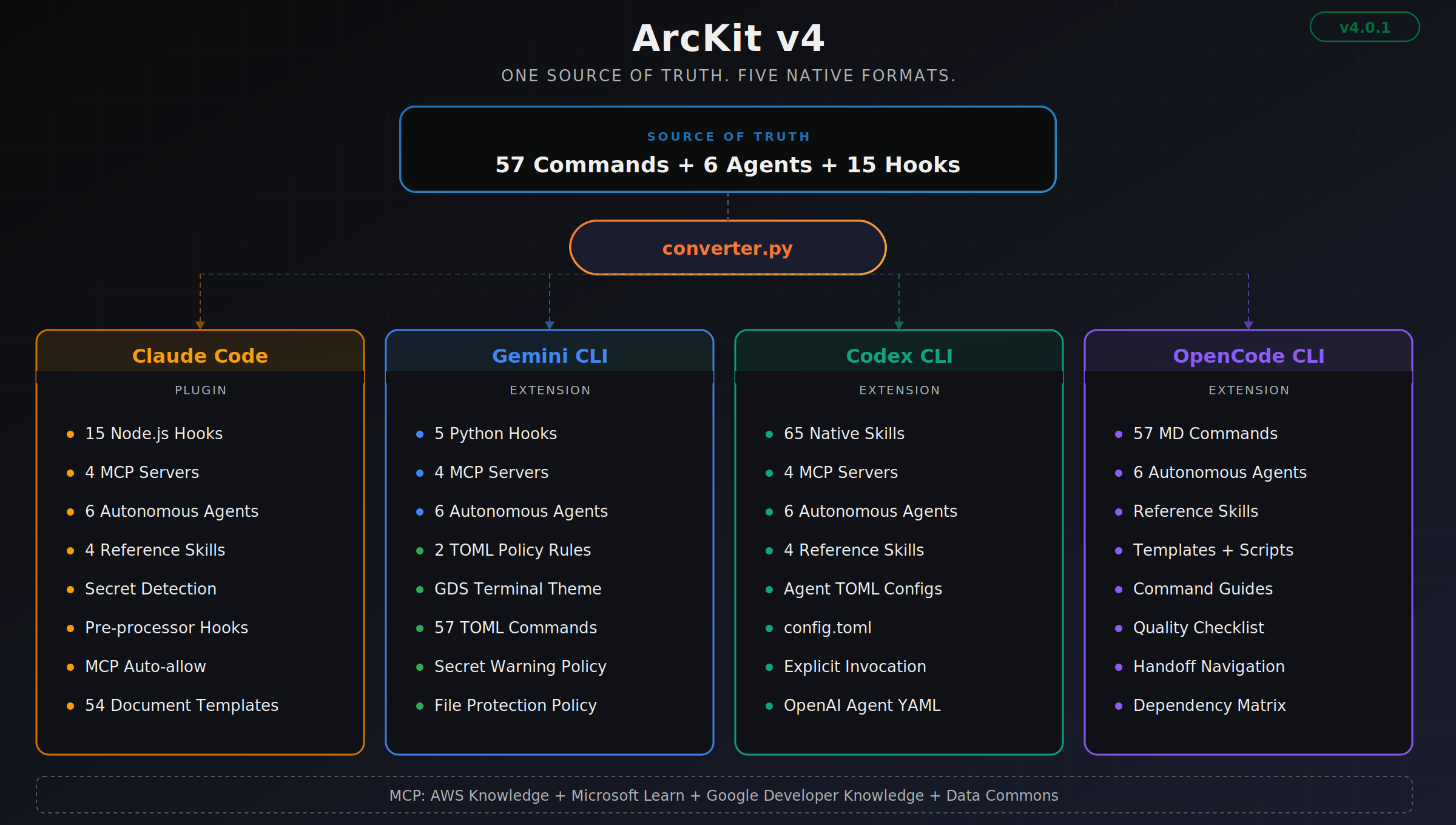
ArcKit v4: First-Class Codex and Gemini Support
The v4 release adds native extensions for Codex CLI and Gemini CLI with hooks, MCP servers, policies, and a redesigned converter pipeline.
Read article →
Community
Community
28 February 2026
The People Behind ArcKit
How open-source contributors are shaping enterprise-architecture tooling, and how to get involved yourself.
Read article →
ArcKit v2.16.3
Release
28 February 2026
ArcKit Recommends Claude Code v2.1.63+
Why the plugin now recommends the latest Claude Code runtime, and what changed in the baseline capability set.
Read article →
Articles are authored in Markdown and rendered on GitHub. Want to suggest a topic or contribute a write-up? Open an issue in the
ArcKit repository.