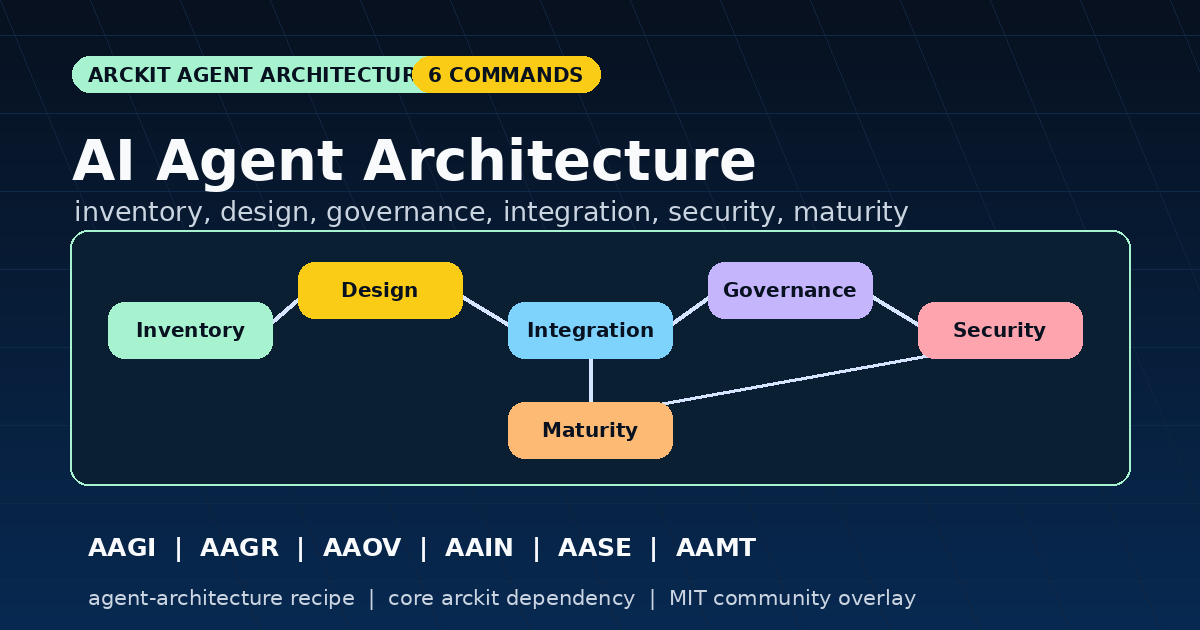
arckit-agent-architecture gives autonomous agent programmes the same
governance discipline ArcKit already brings to requirements, risks, decisions,
assurance, and delivery. It ships six commands and the agent-architecture
build recipe for agent inventory, design, governance, integration, security,
and maturity.
Agents are architecture now
The first wave of AI agent work often starts as experimentation: a prompt, a tool loop, a memory store, a queue, a model choice, and a few permissions that make a workflow useful.
That is fine for discovery. It is not enough for production.
An agent that can inspect repositories, call tools, move data, draft recommendations, trigger workflows, or coordinate with other agents is an architecture component. It has ownership, interfaces, dependencies, failure modes, security posture, audit requirements, and human oversight needs. If it uses memory, acts through tools, or shares state with other agents, those are design decisions, not incidental implementation details.
arckit-agent-architecture exists for that moment: when an agent programme
needs to become explicit enough to govern.
What the overlay adds
The plugin adds six slash commands:
/arckit:agent-inventorycreates an agent register, capability matrix, dependency map, lifecycle view, risk posture, and oversight classification./arckit:agent-designdefines the agent architecture: purpose, autonomy boundary, memory model, tool access, failure handling, and design decisions./arckit:agent-governancesets out the oversight model, approval workflow, audit trail, operating controls, and human intervention points./arckit:agent-integrationdefines agent-to-agent contracts, orchestration, shared state, message protocols, and failure isolation./arckit:agent-securitycovers sandboxing, permissions, data access, threat paths, isolation, and hardening controls./arckit:agent-maturityassesses the maturity of the agent programme and produces an improvement roadmap.
The new ArcKit document codes are AAGI, AAGR, AAOV, AAIN, AASE, and
AAMT. That means agent architecture output lives in the same project
structure as every other governed artefact:
projects/003-agent-programme/
  ARC-003-AAGI-v1.0.md   # Agent inventory
  ARC-003-AAGR-v1.0.md   # Agent architecture specification
  ARC-003-AAOV-v1.0.md   # Agent governance framework
  ARC-003-AAIN-v1.0.md   # Agent integration patterns
  ARC-003-AASE-v1.0.md   # Agent security architecture
  ARC-003-AAMT-v1.0.md   # Agent maturity assessment
Inventory before design
The foundational command is /arckit:agent-inventory.
That is deliberate. Agent programmes become risky when nobody can answer basic questions:
- Which agents exist?
- Who owns each one?
- What tools can they call?
- What data can they see?
- Which model or model family do they use?
- Are they production, staging, development, planned, deprecated, or retired?
- Which ones require human-in-the-loop or human-on-the-loop oversight?
- Which agents depend on each other?
The inventory command turns those questions into a governed artefact. It can read existing ArcKit context such as principles, ADM preliminary work, application inventory, previous agent designs, governance outputs, and security evaluations. The result is not a static asset list. It is the starting point for design, security, integration, governance, and maturity work.
Design, integration, governance, and security
Once the inventory exists, the other commands make the agent programme reviewable.
/arckit:agent-design turns agent intent into architecture. It records what
the agent is for, what autonomy it has, what it can and cannot do, how it uses
memory, what tools it can invoke, what failures look like, and which design
decisions need to be traceable.
/arckit:agent-integration handles the point most teams under-specify:
agent-to-agent and agent-to-system contracts. It asks for protocols, inputs,
outputs, shared state, orchestration, retries, message delivery, observability,
and failure isolation. If agents coordinate, the coordination itself needs an
architecture.
/arckit:agent-governance makes the human control model explicit. That means
approval paths, audit trails, escalation, review cadence, exception handling,
and the boundary between assisted, supervised, and autonomous operation.
/arckit:agent-security treats agents as privileged software components. Tool
permissions, sandboxing, secrets exposure, data classification, prompt
injection paths, model/tool boundary controls, and logging all belong in the
architecture pack.
Together those documents make the agent system something an architecture board can read, challenge, and improve.
The agent-architecture recipe
The overlay also ships the agent-architecture build recipe.
The recipe starts with core ArcKit foundations: principles, requirements, stakeholders, risk, and AI Playbook context. It then builds the agent inventory, design, integration, governance, and security artefacts, with maturity as an optional target.
The shape is:
principles
  -> requirements + stakeholders
  -> risk + AI Playbook
  -> agent inventory
  -> agent design
  -> agent integration + governance + security
  -> optional agent maturity
  -> health + pages
That matters because an agent programme should not sit outside the normal governance baseline. Requirements, stakeholders, risk, AI governance, agent design, and security need to agree with each other.
Getting started
The plugin depends on the core arckit Claude Code plugin:
claude plugin install arckit arckit-agent-architecture
Then run the commands directly:
/arckit:agent-inventory "Casework triage agents"
/arckit:agent-design 003
/arckit:agent-integration 003
/arckit:agent-governance 003
/arckit:agent-security 003
/arckit:agent-maturity 003
Or use the build harness:
/arckit:build 003 --recipe agent-architecture --plan
/arckit:build 003 --recipe agent-architecture
Use --plan first so you can review the target order before generating the
pack.
Scope
This first release is focused on autonomous AI agent programmes: single agents, multi-agent chains, swarms, hierarchical systems, orchestration, human oversight, and security posture.
It is not a general LLM benchmark overlay. It is not a cloud infrastructure
deployment guide. It is not a substitute for regulatory overlays such as
arckit-us, arckit-eu, arckit-uk-nhs, or arckit-uk-finance.
It is the architecture layer for agents themselves.
Why this belongs in ArcKit
ArcKit's central claim has not changed: the toolkit drafts, the architect judges.
Agent architecture needs that bias. AI agents are too consequential to remain as informal prompt chains, but too context-specific to be governed by a single generic checklist. The useful middle path is a set of structured artefacts: inventory, design, governance, integration, security, and maturity.
That gives the architect something concrete to inspect. It gives the team a shared model of what the agents are allowed to do. It gives security and assurance reviewers the evidence they need to challenge the design. And it keeps agent delivery inside the same governed project structure as the rest of the architecture.
That is what arckit-agent-architecture adds: not agent hype, but agent
governance as architecture work.
arckit-agent-architecture is an MIT-licensed community overlay for Claude
Code. It requires the core arckit plugin.
Join the ArcKit Community
- Discord - real-time conversation, help with commands, and what people are building: discord.gg/HsA4Y3hQ4
- LinkedIn Group - announcements, case studies, and longer-form discussion: linkedin.com/groups/17641034
- GitHub - code, issues, and contributions: github.com/tractorjuice/arc-kit