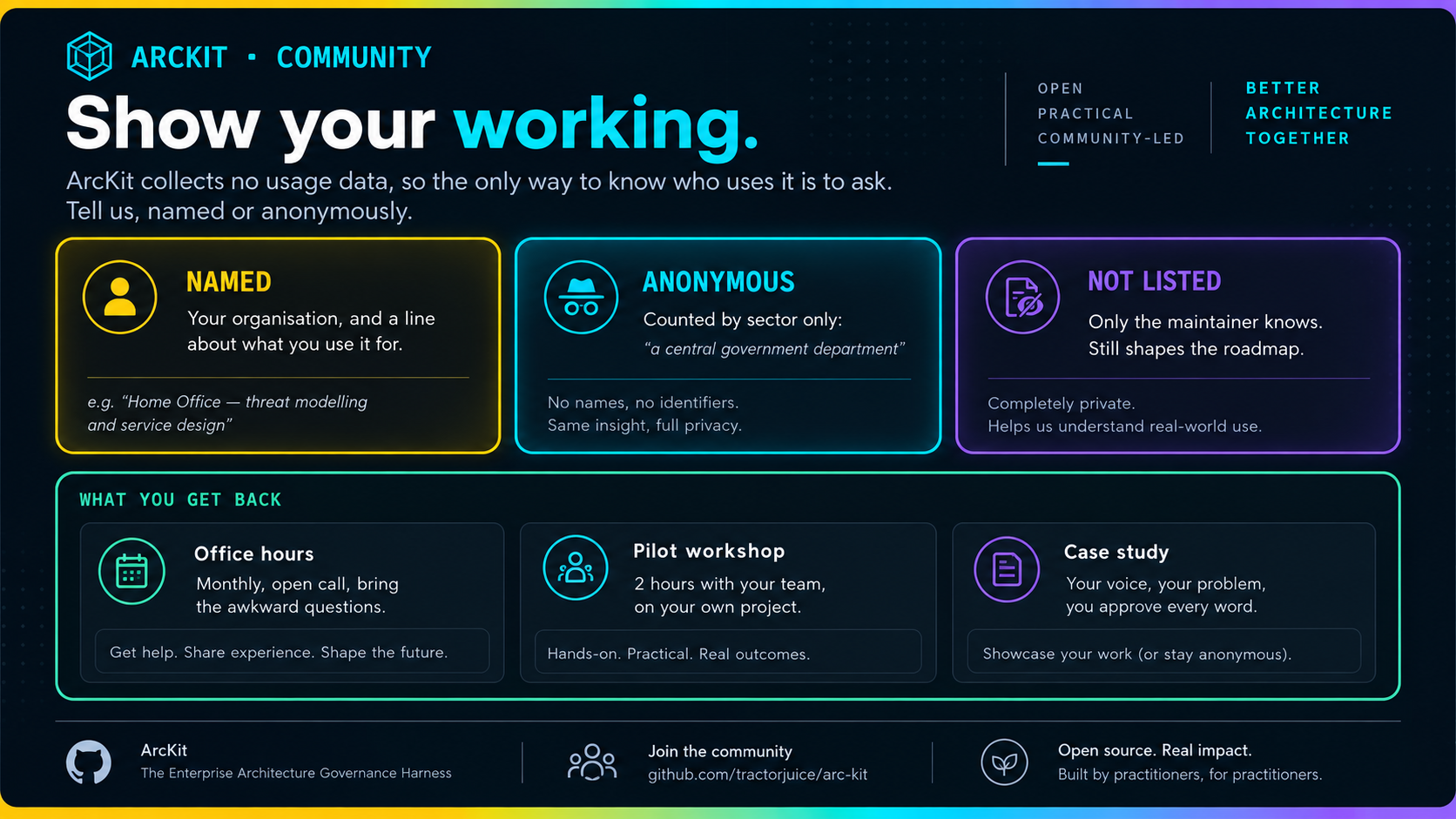
ArcKit has more than 2,200 stars and nearly 280 forks, and I can name almost none of the organisations behind them. That's by design, because ArcKit collects no usage data. So for the rest of this year I'm going to ask. If you use ArcKit, tell me, and you can do it without naming your organisation. In return you get office hours, a free pilot workshop on a real project, and a say in what gets built next.
Mark Craddock · medium.com/arckit
Why I'm asking
Every assessment, spend-control review and design authority I've sat in comes down to one request: show your working. Where did this requirement come from? Which principle does this decision follow? Who looked at the risk, and when? ArcKit exists so that the answer is already written down, traceable, and in the repository next to the work.
Now I need to show mine.
When people ask who uses ArcKit, the honest answer is that I mostly don't know. I can see stars, forks, clones and page views. I can see that people search for it by name, that it has been written up as being used across UK government and the NHS, and that architects in the Netherlands, France and Australia have sent in overlays and fixes for their own countries. What I can't see is which teams have run it on a real project, what it produced for them, and where it fell short.
That's the cost of a decision I would make again. A governance toolkit should not quietly report on the projects it helps. Nothing in ArcKit phones home, and nothing will. But it means the only way to find out is to ask, so this is me asking.
Why it matters to you
A named list of users isn't vanity. It changes what's possible for everyone using ArcKit.
It's the first thing your security, commercial and architecture colleagues will ask before they let you use a new tool on a real project: who else uses this? A list with real organisations on it, even anonymous ones, makes that conversation shorter for the next architect who wants to try it.
It also decides what gets built. The NHS clinical safety overlay, the G-Cloud supplier overlay and the UK Finance payments overlay all exist because someone described a real problem. The roadmap follows the people who tell me what they're doing. At the moment that's a handful of very vocal contributors, and I'd like it to be the teams quietly using it every week.
How to tell me
There's a two-minute form on GitHub called I use ArcKit. It asks your sector, how far you've got, which assistant you use, and what ArcKit helps with. Then you choose how you appear.
You can be named, with your organisation and a line about what you use it for. You can be anonymous, counted only by sector, as "a central government department" or "an NHS trust". That's the option for teams whose communications rules don't allow them to endorse a tool, which I know covers a lot of you. Or you can choose not to be listed, and only I see it.
The form is a public GitHub issue, so your username shows whichever option you pick. If that's a problem, send the same details on Discord or through the LinkedIn group and I'll add you without naming you.
Everyone who replies goes onto a new adopters page in the repository. It starts empty. I'd rather show an honest empty list than a padded one.
Tell us here: github.com/tractorjuice/arc-kit/issues/new?template=adopter.yml
What you get back
Monthly office hours. An hour on an open call, starting in October. I'll post the dates on LinkedIn and Discord. Ten minutes of demo on one of the public test repositories, then your questions. Bring the awkward ones. The second session will be about the one I hear most often: can I use this on OFFICIAL-SENSITIVE work, and what does it do with my documents?
A free pilot workshop. I'm running four this quarter. Two hours with your team, on one of your own projects or on a public test project if classification makes that easier. We start from a blank repository and finish with a first set of governance documents: requirements, then whichever assessment you have coming up. You keep everything and it lives in your repository. The only thing that leaves it is what your AI assistant already sends to its model provider. Tick the workshop box on the form and I'll be in touch.
A case study, if you want one. If ArcKit made a real difference, I'd like to write it up with you. That means a thirty-minute conversation, and you approve every word before it's published. If your department blog would rather publish it themselves, even better. Your voice about your problem is worth more than anything I can say about my tool.
If you're still deciding
If you've starred ArcKit but haven't used it on a real project yet, the new page for UK public sector architects at arckit.org/public-sector.html is written for you. It covers what ArcKit produces for a Technology Code of Practice review, a Service Standard assessment and a Secure by Design pack. It explains how classification works and what stays on your machine. And it answers the question I get asked most: how can you trust AI-written governance documents? The short answer is that every claim cites its source, every document records how it was made, and there's a single page listing which rules the tool enforces and which ones still depend on the AI following instructions.
It's free and MIT licensed. It runs inside AI coding assistants, including GitHub Copilot (the coding assistant, not the Microsoft 365 one). If your team already has one approved, there's nothing new to buy.
Thank you
To everyone who has starred, forked, filed an issue, sent a fix or written about ArcKit: thank you. Special thanks to @umag, @thomas-jardinet, @royster70, @chrismckelt and @johnfelipe, whose overlays, fixes, bug reports and feature requests shaped this summer's work.
Now show me your working.
ArcKit is MIT licensed and maintained at github.com/tractorjuice/arc-kit. Current release: v6.14.0.
Join the ArcKit Community
- Discord - real-time conversation, help with commands, and what people are building: discord.gg/HsA4Y3hQ4
- LinkedIn Group - announcements, case studies, and longer-form discussion: linkedin.com/groups/17641034
- GitHub - code, issues, and contributions: github.com/tractorjuice/arc-kit